%20--%3e%3csvg%20version='1.1'%20id='Layer_1'%20xmlns='http://www.w3.org/2000/svg'%20xmlns:xlink='http://www.w3.org/1999/xlink'%20x='0px'%20y='0px'%20viewBox='0%200%201440%20384.8'%20style='enable-background:new%200%200%201440%20384.8;'%20xml:space='preserve'%3e%3cstyle%20type='text/css'%3e%20.st0{fill:%23010101;}%20%3c/style%3e%3cg%3e%3cpath%20class='st0'%20d='M156.5,162.6c0,32.3-14.1,52.7-42.3,61.1l51.3,71.2h-42.1L76.6,229H33.1v65.9H0v-196h72.9%20c29.9,0,51.3,5,64.2,15.1C150,124.2,156.5,140.3,156.5,162.6z%20M112.5,190.3c6.7-5.8,10.1-15.1,10.1-27.9c0-12.8-3.5-21.6-10.4-26.4%20c-6.9-4.8-19.3-7.2-37-7.2H33.1V199h41.2C93,199,105.7,196.1,112.5,190.3z'/%3e%3cpath%20class='st0'%20d='M407.1,124.7c-9.6,0-17.5,2-23.7,5.9c-6.2,3.9-9.3,9.9-9.3,17.8c0,7.9,3.1,14,9.3,18.2%20c6.2,4.2,19.3,8.7,39.4,13.6c20.1,4.9,35.2,11.7,45.4,20.5c10.2,8.8,15.3,21.7,15.3,38.8c0,17.1-6.5,31-19.3,41.6%20c-12.9,10.7-29.8,16-50.8,16c-30.7,0-57.9-10.6-81.6-31.7l20.8-25c19.8,17.2,40.4,25.8,61.7,25.8c10.7,0,19.1-2.3,25.4-6.9%20c6.3-4.6,9.4-10.7,9.4-18.2c0-7.6-2.9-13.5-8.8-17.7c-5.9-4.2-16-8-30.4-11.5c-14.4-3.5-25.3-6.6-32.8-9.5%20c-7.5-2.9-14.1-6.7-19.9-11.4c-11.6-8.8-17.4-22.2-17.4-40.4s6.6-32.1,19.8-41.9c13.2-9.8,29.5-14.7,48.9-14.7%20c12.5,0,25,2.1,37.3,6.2c12.3,4.1,23,9.9,32,17.4l-17.7,25c-5.8-5.2-13.7-9.5-23.6-12.9C426.5,126.4,416.7,124.7,407.1,124.7z'/%3e%3cpath%20class='st0'%20d='M690.2,98.9V130H585.6v51.9h93.9v29.4h-93.9v52.4h108v31.1H552.5v-196H690.2z'/%3e%3cg%3e%3cpath%20class='st0'%20d='M868.7,250.3l-19.6,44.6h-35.3l86.4-196h35.3l86.4,196h-35.3l-19.6-44.6H868.7z%20M953.4,219.8L917.8,139%20l-35.6,80.8H953.4z'/%3e%3cpath%20class='st0'%20d='M1233.6,162.6c0,32.3-14.1,52.7-42.3,61.1l51.3,71.2h-42.1l-46.8-65.9h-43.5v65.9h-33.1v-196h72.9%20c29.9,0,51.3,5,64.2,15.1C1227.1,124.2,1233.6,140.3,1233.6,162.6z%20M1189.6,190.3c6.7-5.8,10.1-15.1,10.1-27.9%20c0-12.8-3.5-21.6-10.4-26.4c-6.9-4.8-19.3-7.2-37-7.2h-42.1V199h41.2C1170.1,199,1182.8,196.1,1189.6,190.3z'/%3e%3cpath%20class='st0'%20d='M1380.5,129.2v165.7h-33.1V129.2H1288V98.9h152v30.3H1380.5z'/%3e%3c/g%3e%3cg%3e%3crect%20x='234.9'%20y='0'%20class='st0'%20width='29.1'%20height='384.8'/%3e%3c/g%3e%3c/g%3e%3c/svg%3e)

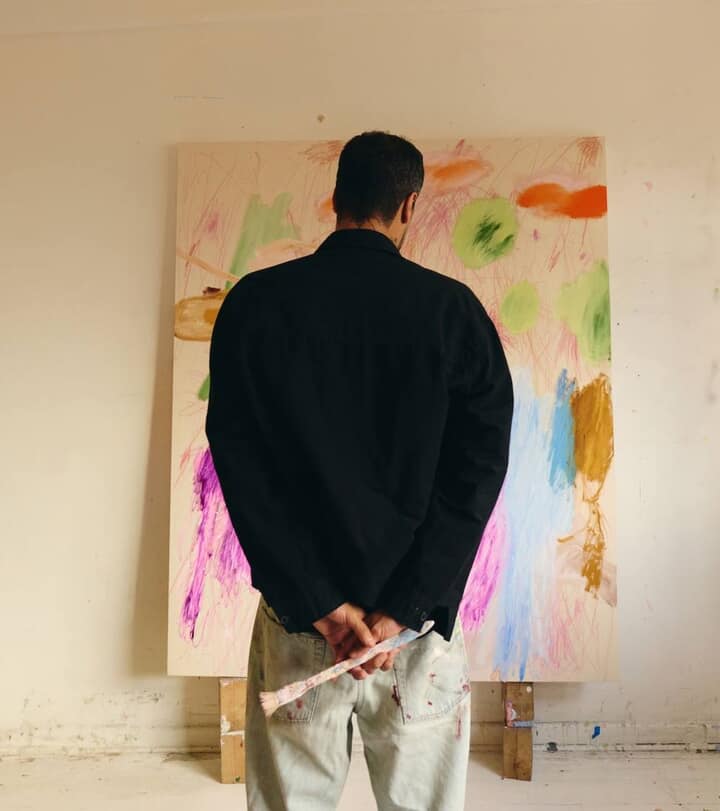
Your practice approaches memory not as a fixed record of the past, but as something unstable and fragmented. Do you see painting as an attempt to preserve something that would otherwise be lost, or as a way of embracing the impossibility of truly recovering the past?
Painting can be both, but I’m more drawn to making something intangible feel tangible. I’m interested in how something that’s constantly in flux, whether it’s a memory, an impulse or an emotion, can take on a physical presence through painting. I see it as a form of translation, where these experiences become colour, texture, composition and scale. It’s essentially the same language, just expressed through different means.
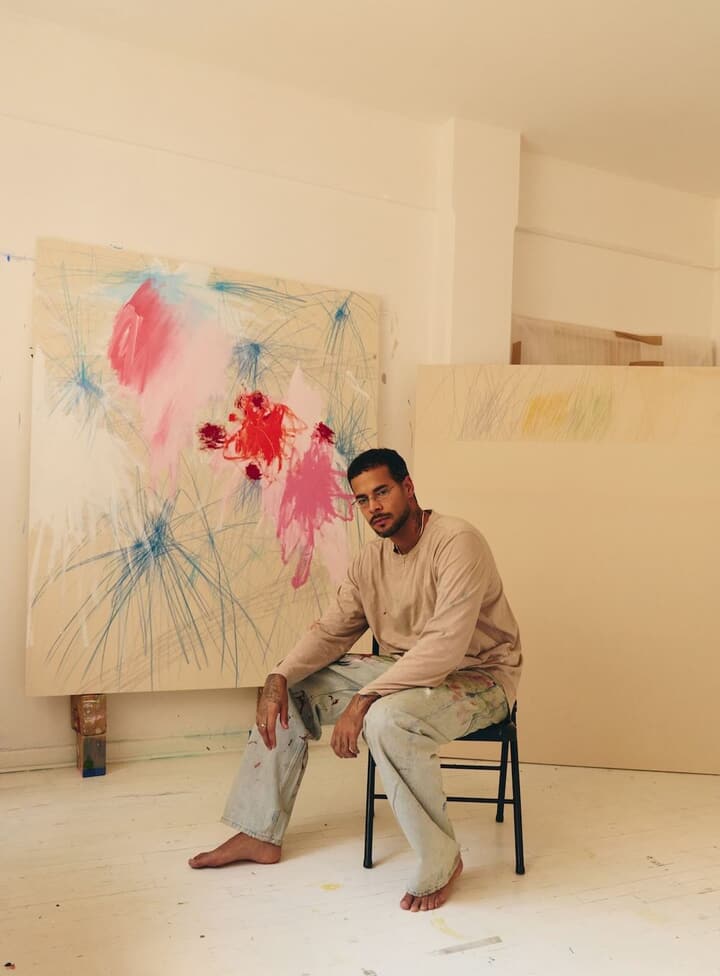
Having grown up in Venezuela and subsequently established your artistic life in Mexico City, you inhabit a personal geography shaped by different cultural environments and experiences. How have these transitions altered your relationship with landscape, identity and belonging?
Moving between different places and cultures has made me much more aware of my surroundings and how I relate to the world. It’s made me more observant and, in some ways, more aware of things I hadn’t paid attention to before, even within my own culture. There’s something about being in a state of transition that makes you hyperaware of everything around you. You begin noticing small details, questioning things you once took for granted, and seeing familiar things differently. I guess it’s also made me less attached to belonging to one particular place. That sense of belonging can shift and exist in different places at once.
In your paintings, landscape appears less as a recognisable physical environment and more as an emotional or psychological territory. Rather than depicting a particular place, you seem to reconstruct the sensations associated with being somewhere. What interests you about this movement from external landscape to internal experience?
Painting a landscape exactly as it is would feel too literal to me. I’m much more interested in evoking a place rather than representing it. Sometimes the feeling of a place can be more vivid than the place itself. I don’t necessarily want someone looking at my paintings to recognise a particular landscape, or to tell them what they’re supposed to see. I’d rather leave room for their own experience and interpretation. For me, it’s less about what a place looks like and more about what it feels like to be there. In a way, it’s our own perception that ends up shaping the landscape, rather than the other way around.
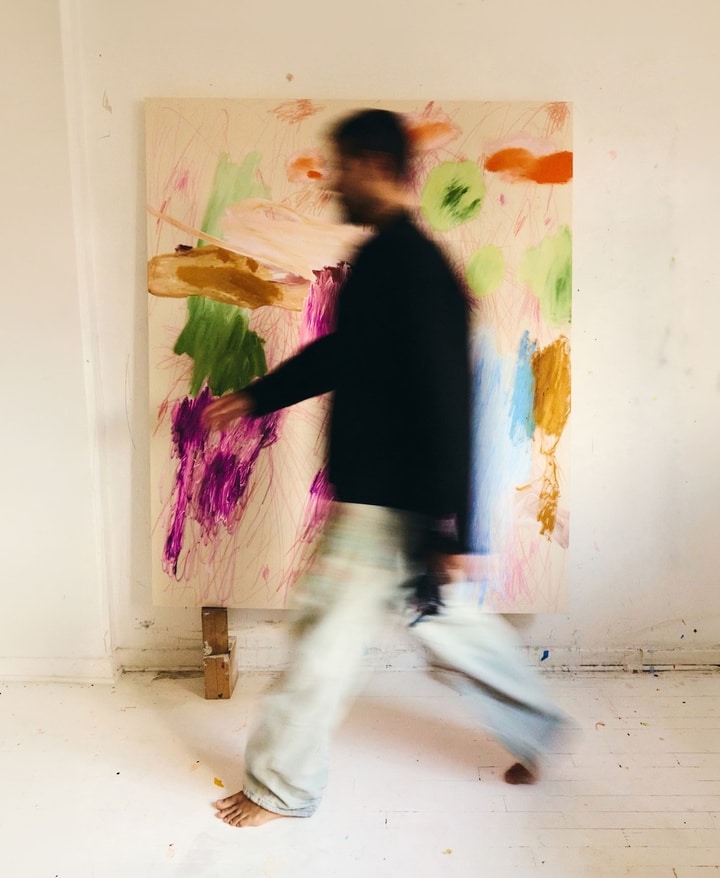
Your paintings often hold a tension between expressive gestures, accumulated layers and moments of erasure. How do you recognise when a painting has reached its necessary point of resolution?
I’m constantly working back and forth when I paint, adding and subtracting, sometimes covering something only to reveal it again. It’s not really a linear process. Over time, I’ve learned to trust my intuition when it comes to knowing when to stop. When I feel a painting might be finished, I usually cover it and leave it alone for a few days. Then I come back to it with fresh eyes, and if it still excites me, if there’s still something happening within it, then I know it’s finished. I’m not necessarily looking for formal perfection. What matters to me is that the painting retains a certain energy, a sense that something is still happening within it.
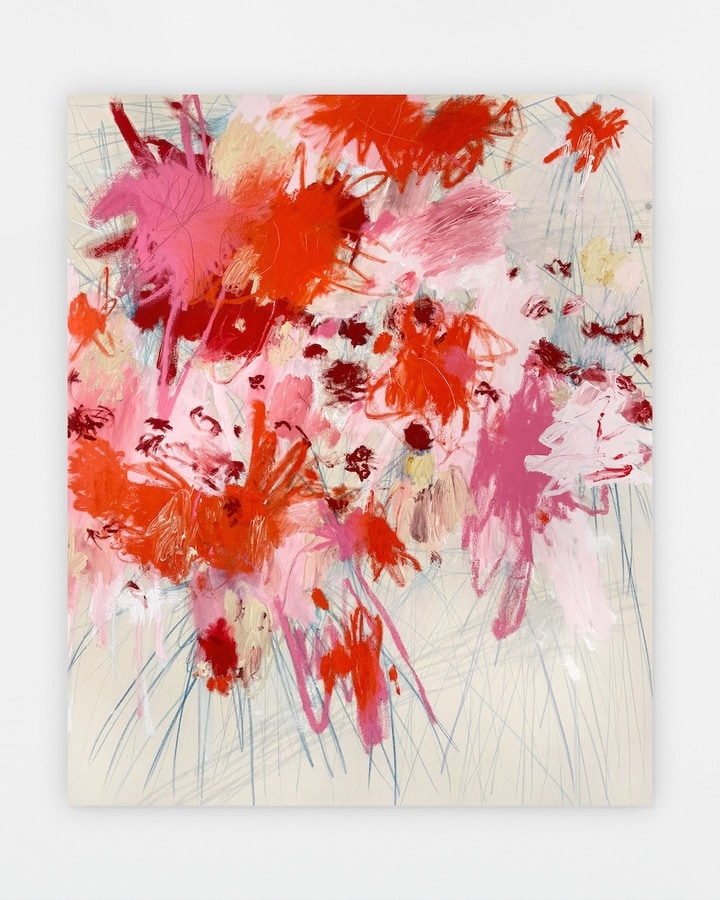
Your training in ceramic production introduced you to a material language quite different from that of painting, involving touch, resistance, transformation and permanence. How has working with clay influenced your understanding of painting, and vice versa?
Working with ceramics has definitely changed the way I approach painting. For me, abstract painting has always been very gestural, and for a long time my process was quite explosive, fast, almost like an immediate release of energy. Ceramics was a very different experience. It forced me to slow down and, in a way, to let go of some of that control. With clay, you quickly realise that the material doesn’t always respond the way you expect it to. You have to pay attention to what it’s doing rather than just what you want it to do. I think that’s something I’ve brought back into painting, being less concerned with controlling everything and more open to what happens along the way.
Do you approach materials as neutral instruments of expression, or do you believe they possess their own emotional and conceptual intelligence?
I don’t see materials as neutral instruments. Each material has its own language, its own qualities and limitations, and I believe there’s a certain intelligence within that. You can’t really explore a material’s full potential if you don’t acknowledge what it brings to the process. For me, it’s as much about understanding the nature of the material as it is about what I intend to do with it.
Your exhibition Cuerpo Voraz explores the human body as a vessel for memory, desire and vulnerability. This introduces a more corporal dimension to your exploration of memory. What prompted this shift towards the body, and do you see it as another landscape through which experience can be mapped?
I’ve always thought of the body as a kind of territory, something we inhabit that holds both tangible and intangible experiences. So for me, it never really felt like a shift, but more like another area to explore. What interests me is how the physical and psychological coexist within it, and how one can leave traces on the other. A scar, for example, is a visible reminder of something that happened in the past, but there are also experiences that leave no visible mark and still become part of us. In that sense, I see the body as a living archive of our experiences.
There is an intriguing tension in the title Fragmentos Permanentes: the idea that something inherently fleeting, such as a memory or emotion, might acquire permanence through artistic expression. Do you think an artwork can ever truly preserve an experience?
Fragmentos Permanentes plays with the idea that certain memories can become so deeply rooted in our psyche that they stay with us, sometimes even shaping who we are. I don’t necessarily think an artwork can preserve an experience exactly as it was, nor would I want to limit it to that. The experience of an artwork is never entirely determined by the artist. It also depends on the person encountering it, what they bring to it, and how they relate to it. An artwork can carry something of what inspired it while also becoming something entirely new. It’s an experience in itself, both for the person making it and the person looking at it.
As your practice develops, what questions remain unresolved for you? Are there territories you feel you have yet to explore?
I feel like I haven’t even scratched the surface yet. The more I question and explore, the more things seem to open up and unravel, and the questions only get deeper. I’m still very interested in memory and the human experience, especially that space where memories and dreams begin to blur, where you’re not entirely sure what was lived, remembered or imagined. Lately, I’ve also been thinking about colour as a lived experience, something shaped by everything we’ve seen and absorbed over time, almost like an accumulation of our own visual imagination. And I’m still trying to understand how all these ideas connect and influence one another.
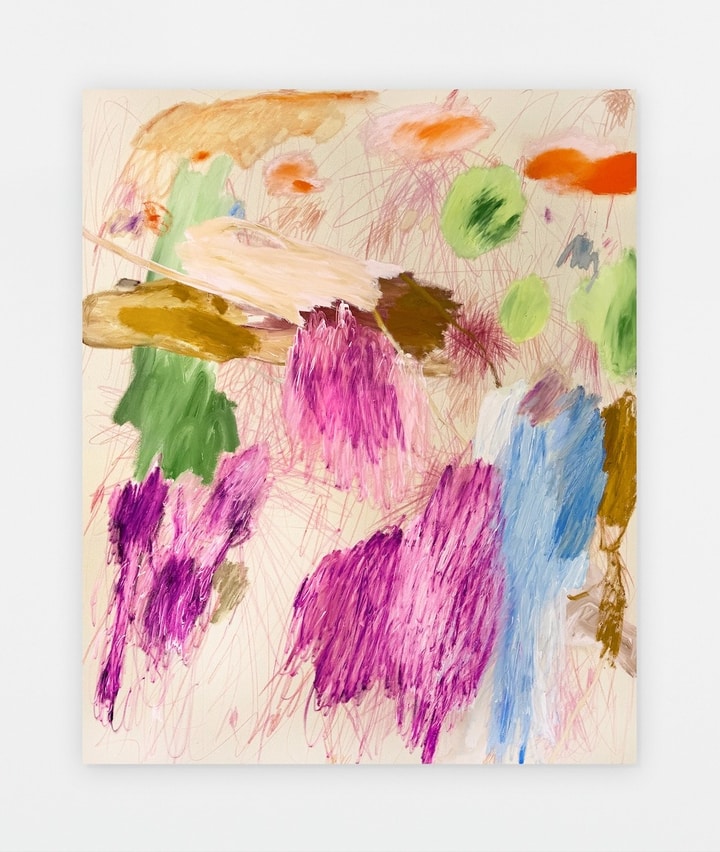
Your practice increasingly moves between painting and three-dimensional forms, with ceramics providing a particularly distinctive vocabulary. What interests you about multidisciplinary practices?
As a visual artist, I don’t want to feel constrained to a particular medium. What interests me is how each medium offers a different vantage point, not just another way of making something, but another way of approaching an idea. Painting and sculpture make me think differently, and moving between them often brings up questions I wouldn’t have encountered otherwise. I also like the possibility of bringing these different languages together, of having them interact rather than exist separately. There’s something about that process that feels like world-building to me. It allows the work to expand into something I couldn’t have arrived at through a single medium.
In your view, what possibilities emerge when an artwork moves beyond the visual and begins to engage other senses?
Our senses are closely connected to memory, sometimes in ways we’re not even fully aware of. A particular smell, sound or texture can bring back an experience almost instantly, sometimes more vividly than an image. I like the possibility of working with those associations, of creating something that can be experienced on different levels. An artwork doesn’t necessarily have to engage every sense directly, but it can suggest sensations that go beyond what we’re looking at. I think there’s something interesting about how much we can experience without necessarily seeing it.