%20--%3e%3csvg%20version='1.1'%20id='Layer_1'%20xmlns='http://www.w3.org/2000/svg'%20xmlns:xlink='http://www.w3.org/1999/xlink'%20x='0px'%20y='0px'%20viewBox='0%200%201440%20384.8'%20style='enable-background:new%200%200%201440%20384.8;'%20xml:space='preserve'%3e%3cstyle%20type='text/css'%3e%20.st0{fill:%23010101;}%20%3c/style%3e%3cg%3e%3cpath%20class='st0'%20d='M156.5,162.6c0,32.3-14.1,52.7-42.3,61.1l51.3,71.2h-42.1L76.6,229H33.1v65.9H0v-196h72.9%20c29.9,0,51.3,5,64.2,15.1C150,124.2,156.5,140.3,156.5,162.6z%20M112.5,190.3c6.7-5.8,10.1-15.1,10.1-27.9c0-12.8-3.5-21.6-10.4-26.4%20c-6.9-4.8-19.3-7.2-37-7.2H33.1V199h41.2C93,199,105.7,196.1,112.5,190.3z'/%3e%3cpath%20class='st0'%20d='M407.1,124.7c-9.6,0-17.5,2-23.7,5.9c-6.2,3.9-9.3,9.9-9.3,17.8c0,7.9,3.1,14,9.3,18.2%20c6.2,4.2,19.3,8.7,39.4,13.6c20.1,4.9,35.2,11.7,45.4,20.5c10.2,8.8,15.3,21.7,15.3,38.8c0,17.1-6.5,31-19.3,41.6%20c-12.9,10.7-29.8,16-50.8,16c-30.7,0-57.9-10.6-81.6-31.7l20.8-25c19.8,17.2,40.4,25.8,61.7,25.8c10.7,0,19.1-2.3,25.4-6.9%20c6.3-4.6,9.4-10.7,9.4-18.2c0-7.6-2.9-13.5-8.8-17.7c-5.9-4.2-16-8-30.4-11.5c-14.4-3.5-25.3-6.6-32.8-9.5%20c-7.5-2.9-14.1-6.7-19.9-11.4c-11.6-8.8-17.4-22.2-17.4-40.4s6.6-32.1,19.8-41.9c13.2-9.8,29.5-14.7,48.9-14.7%20c12.5,0,25,2.1,37.3,6.2c12.3,4.1,23,9.9,32,17.4l-17.7,25c-5.8-5.2-13.7-9.5-23.6-12.9C426.5,126.4,416.7,124.7,407.1,124.7z'/%3e%3cpath%20class='st0'%20d='M690.2,98.9V130H585.6v51.9h93.9v29.4h-93.9v52.4h108v31.1H552.5v-196H690.2z'/%3e%3cg%3e%3cpath%20class='st0'%20d='M868.7,250.3l-19.6,44.6h-35.3l86.4-196h35.3l86.4,196h-35.3l-19.6-44.6H868.7z%20M953.4,219.8L917.8,139%20l-35.6,80.8H953.4z'/%3e%3cpath%20class='st0'%20d='M1233.6,162.6c0,32.3-14.1,52.7-42.3,61.1l51.3,71.2h-42.1l-46.8-65.9h-43.5v65.9h-33.1v-196h72.9%20c29.9,0,51.3,5,64.2,15.1C1227.1,124.2,1233.6,140.3,1233.6,162.6z%20M1189.6,190.3c6.7-5.8,10.1-15.1,10.1-27.9%20c0-12.8-3.5-21.6-10.4-26.4c-6.9-4.8-19.3-7.2-37-7.2h-42.1V199h41.2C1170.1,199,1182.8,196.1,1189.6,190.3z'/%3e%3cpath%20class='st0'%20d='M1380.5,129.2v165.7h-33.1V129.2H1288V98.9h152v30.3H1380.5z'/%3e%3c/g%3e%3cg%3e%3crect%20x='234.9'%20y='0'%20class='st0'%20width='29.1'%20height='384.8'/%3e%3c/g%3e%3c/g%3e%3c/svg%3e)

Designers can't seem to get enough of Carolin Kreutzer's work, and it's not hard to see why. At a moment defined by visual excess and information consumption, Kreutzer respects a fairly urgent need for quiet and recalibration. Her paintings offer something increasingly hard to come by: space to pause and reflect.
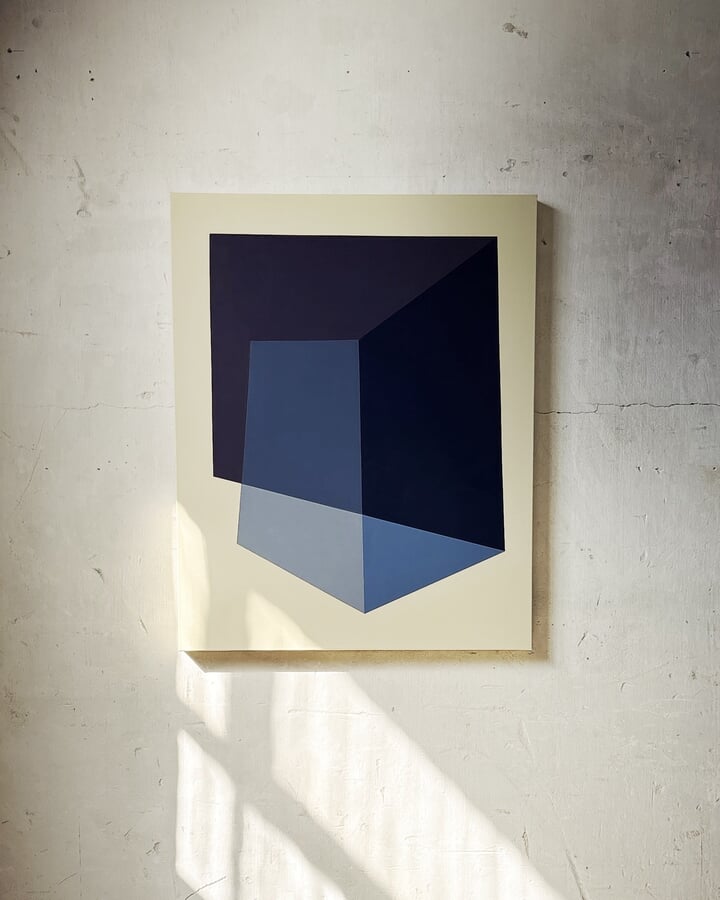
Working at the intersection of reduction and possibility, Kreutzer uses light, colour and subtle shifts in composition to create paintings that feel both spare and expansive. Over the past few weeks, she has been working on As Far As I Can See, now available on Rise Art.
Here, Kreutzer shares footage of the painting’s creation and reflects on her practice, offering a closer look at the layers, decisions and sustained attention behind her sought-after works.
How do you translate feelings and thoughts through colour and shape?
It usually starts with a feeling or a question. While I sketch and paint, I spend so much time with it that it becomes tangible. I translate it into simple shapes and keep reducing until only the essence of the form is left. Form is the foundation of every piece I make.
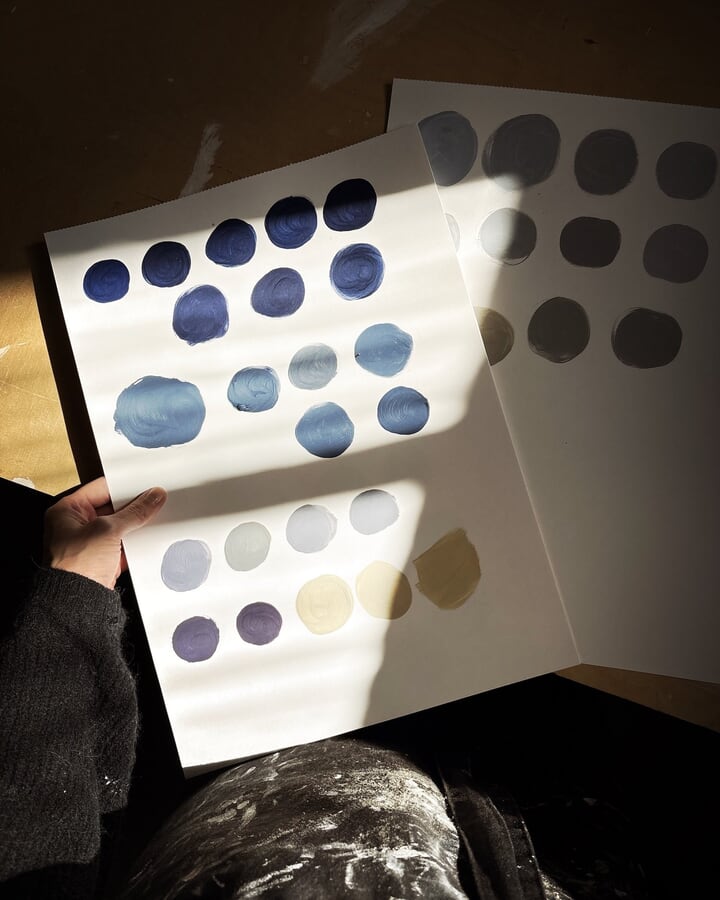
Colour comes in afterwards, and I reduce that as well. I usually stay within one colour family and use several muted shades of it to create a sense of space. The colours don’t demand attention. They make room for it.
That reduction brings calm and allows concentration, both for me while painting and for the person looking at the work.
What appeals to you most about minimalist art?
What appeals to me most is that you can say a lot with very little. When you reduce something to its essence, what remains carries weight.
Attention is precious, and a lot of what surrounds us takes it without asking. Minimalism treats it with respect. That’s an attitude I value not only in art but in life in general.
For me, that’s what makes ‘quiet work’ interesting. It doesn’t need volume to have presence.
How do you balance constraint and harmony in your work?
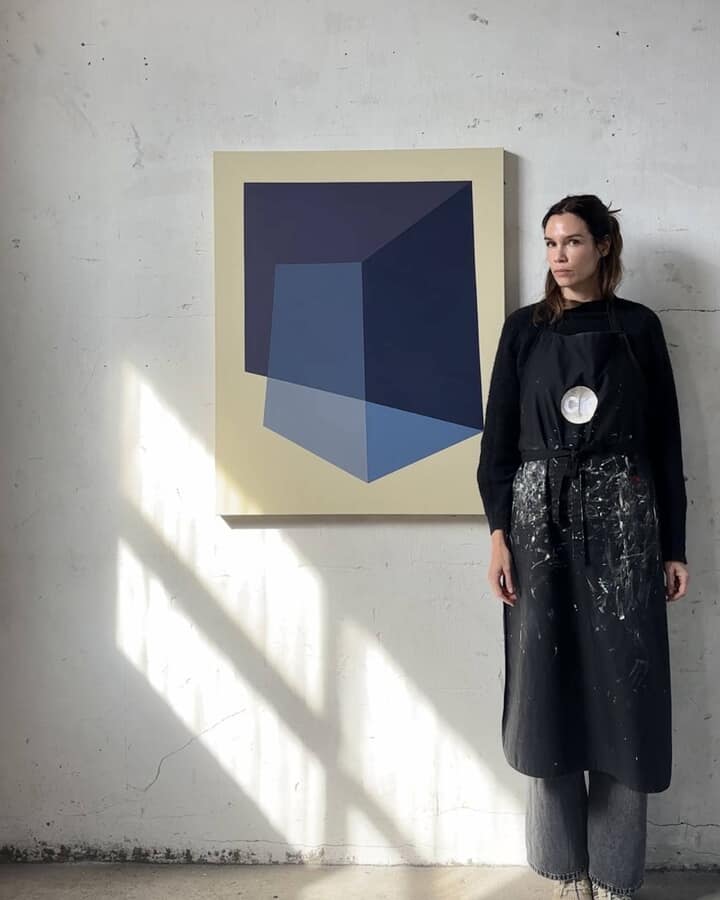
For me, constraint and harmony are two sides of the same process. My shapes are simple and timeless, and every one of them has a hard edge. That’s the constraint: it creates the clarity I need.
Within those edges, the colours are soft, with several nuances. Where shapes overlap, the tone shifts and a sense of depth opens up, as if the shapes were rooms you could look into. What fascinates me, and what keeps driving me, is the tension between the two.
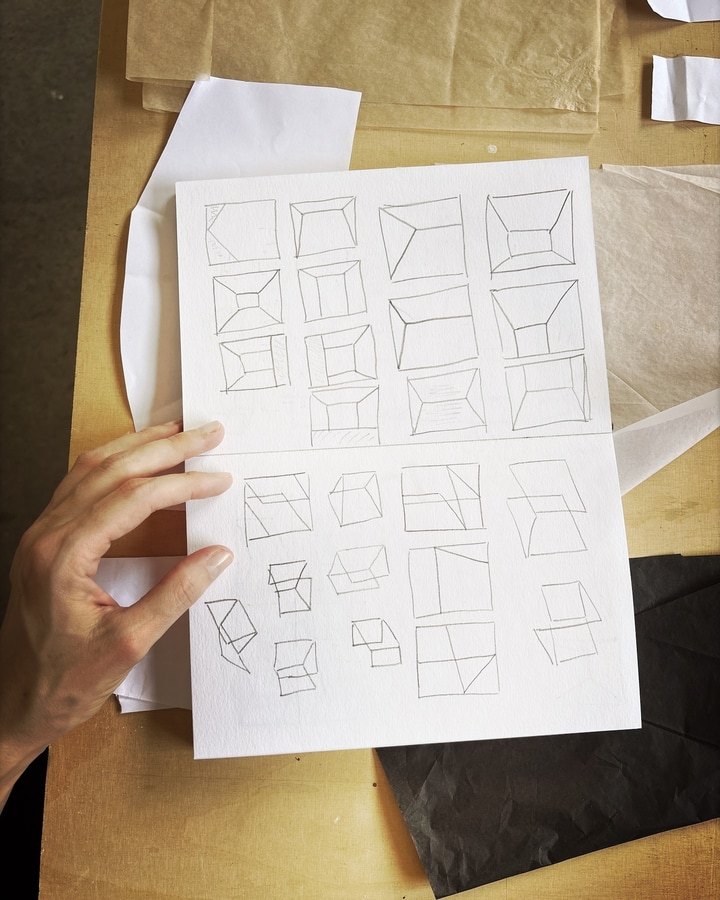
To find the balance, I let my drafts rest for days or even weeks, then look at them again and refine them until they reach the greatest harmony I can find.
How do you bring a sense of playfulness to your work?
The finished work is clear and structured. The playfulness happens before that, in the process. I play with colour: I look for new colours and fan them out into gradations, and I watch how they grow into a space. I fold, I try things out, and I keep discovering new shapes and overlaps. It’s a small universe of my own that never stops revealing itself.
Who are your biggest inspirations or influences?
My biggest source of inspiration is light. On my daily walks, I notice how it changes colours and moods, and I store them. They flow into my work.
Other artists have shaped me, especially when I was finding my own way, and they still do. Agnes Martin, for her reduction. Josef Albers is my greatest role model when it comes to colour: through him I learned that colours exist in relation to each other, which I see every day in my own work. And Mark Rothko, because we all know how immense the effect of colour in front of one of his paintings can be.
What advice would you give your past self, knowing what you know now?
When I started painting six years ago, I didn’t get applause. I got a lot of headwind, even from my closest circle. I felt pushed into a role that never suited me. So it took some courage just to begin. Looking back, that’s exactly where my painting and my themes grew from.
If I could talk to my past self, I’d tell her to turn towards her own inner world and keep listening to her own voice. Because through my work, I now get to live something I always wanted and never thought possible. Life isn’t perfect, of course, but I got here by carrying on quietly, one painting at a time.
Where do you see yourself and your practice in five years?
In five years, I see myself painting and living from my art. I want to keep developing my style and crea- te more large-format works.
I’d like to keep working with galleries and on interior projects, and to show my work in new places. Because I love to travel, I hope to discover many more of them along the way. One of the best things about my work is meeting inspiring people and seeing what we create together. I hope there will be many more of these projects, surrounded by a strong and supportive network.
What matters most is simply being able to keep painting, with the space and time it needs. That is not a given these days, and I’m very grateful for it.