%20--%3e%3csvg%20version='1.1'%20id='Layer_1'%20xmlns='http://www.w3.org/2000/svg'%20xmlns:xlink='http://www.w3.org/1999/xlink'%20x='0px'%20y='0px'%20viewBox='0%200%201440%20384.8'%20style='enable-background:new%200%200%201440%20384.8;'%20xml:space='preserve'%3e%3cstyle%20type='text/css'%3e%20.st0{fill:%23010101;}%20%3c/style%3e%3cg%3e%3cpath%20class='st0'%20d='M156.5,162.6c0,32.3-14.1,52.7-42.3,61.1l51.3,71.2h-42.1L76.6,229H33.1v65.9H0v-196h72.9%20c29.9,0,51.3,5,64.2,15.1C150,124.2,156.5,140.3,156.5,162.6z%20M112.5,190.3c6.7-5.8,10.1-15.1,10.1-27.9c0-12.8-3.5-21.6-10.4-26.4%20c-6.9-4.8-19.3-7.2-37-7.2H33.1V199h41.2C93,199,105.7,196.1,112.5,190.3z'/%3e%3cpath%20class='st0'%20d='M407.1,124.7c-9.6,0-17.5,2-23.7,5.9c-6.2,3.9-9.3,9.9-9.3,17.8c0,7.9,3.1,14,9.3,18.2%20c6.2,4.2,19.3,8.7,39.4,13.6c20.1,4.9,35.2,11.7,45.4,20.5c10.2,8.8,15.3,21.7,15.3,38.8c0,17.1-6.5,31-19.3,41.6%20c-12.9,10.7-29.8,16-50.8,16c-30.7,0-57.9-10.6-81.6-31.7l20.8-25c19.8,17.2,40.4,25.8,61.7,25.8c10.7,0,19.1-2.3,25.4-6.9%20c6.3-4.6,9.4-10.7,9.4-18.2c0-7.6-2.9-13.5-8.8-17.7c-5.9-4.2-16-8-30.4-11.5c-14.4-3.5-25.3-6.6-32.8-9.5%20c-7.5-2.9-14.1-6.7-19.9-11.4c-11.6-8.8-17.4-22.2-17.4-40.4s6.6-32.1,19.8-41.9c13.2-9.8,29.5-14.7,48.9-14.7%20c12.5,0,25,2.1,37.3,6.2c12.3,4.1,23,9.9,32,17.4l-17.7,25c-5.8-5.2-13.7-9.5-23.6-12.9C426.5,126.4,416.7,124.7,407.1,124.7z'/%3e%3cpath%20class='st0'%20d='M690.2,98.9V130H585.6v51.9h93.9v29.4h-93.9v52.4h108v31.1H552.5v-196H690.2z'/%3e%3cg%3e%3cpath%20class='st0'%20d='M868.7,250.3l-19.6,44.6h-35.3l86.4-196h35.3l86.4,196h-35.3l-19.6-44.6H868.7z%20M953.4,219.8L917.8,139%20l-35.6,80.8H953.4z'/%3e%3cpath%20class='st0'%20d='M1233.6,162.6c0,32.3-14.1,52.7-42.3,61.1l51.3,71.2h-42.1l-46.8-65.9h-43.5v65.9h-33.1v-196h72.9%20c29.9,0,51.3,5,64.2,15.1C1227.1,124.2,1233.6,140.3,1233.6,162.6z%20M1189.6,190.3c6.7-5.8,10.1-15.1,10.1-27.9%20c0-12.8-3.5-21.6-10.4-26.4c-6.9-4.8-19.3-7.2-37-7.2h-42.1V199h41.2C1170.1,199,1182.8,196.1,1189.6,190.3z'/%3e%3cpath%20class='st0'%20d='M1380.5,129.2v165.7h-33.1V129.2H1288V98.9h152v30.3H1380.5z'/%3e%3c/g%3e%3cg%3e%3crect%20x='234.9'%20y='0'%20class='st0'%20width='29.1'%20height='384.8'/%3e%3c/g%3e%3c/g%3e%3c/svg%3e)

What makes an everyday scene worth preserving in paint? Or, how do you know when you've found a scene that deserves to become a painting?
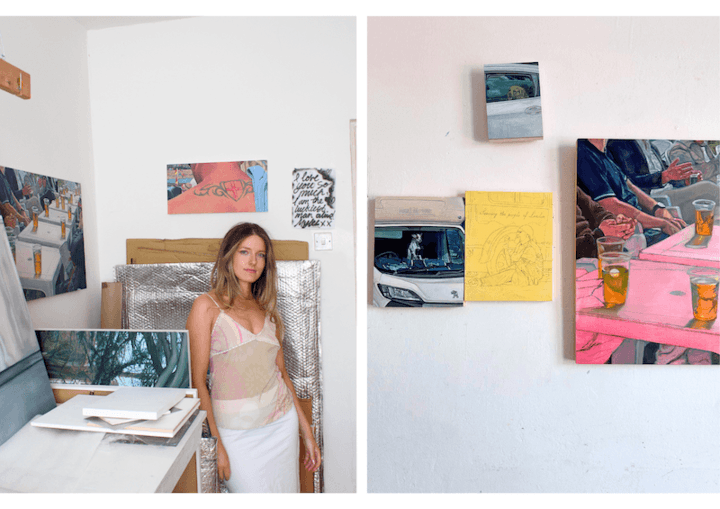
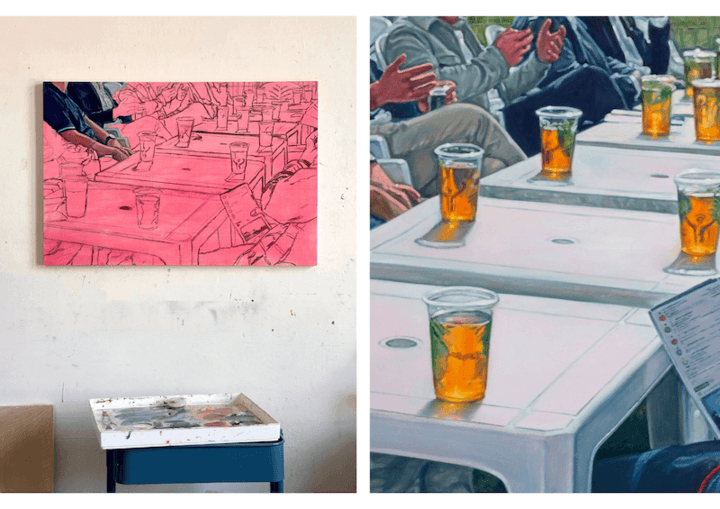
Something will catch my eye, often just in my periphery. Either someone is doing something I find funny, or the light is hitting something in an interesting way. Usually it's an ordinary-looking scene, but there's something slightly off about it. It might be a misplaced plastic chair, a row of sixteen identical pints, or a tough-looking bloke doing something unexpectedly gentle, such as in Soft (2026). Sometimes it's simply something familiar that stirs feelings of nostalgia or empathy.
Is there a particular ritual of the British summer that you find endlessly fascinating?
The culture of all-day drinking, pub gardens, football (although I have no interest in it), Wimbledon (likewise), barbecues and sunburn. Everyone seems to be in a better mood. For me, I think it's more about the art of documenting the atmosphere than any one specific ritual.
Are there recurring behaviours or social rituals that you find yourself returning to again and again?
Small pleasures like an ice cream or a pint, and the pub in general. I'm also drawn to the boring, repetitive cycle of commuting on the bus, train or Underground, working an unfulfilling job, and then going home to sleep.
What details do most people overlook that immediately catch your eye?
The exhausted faces of people on a long commute. People who aren't hiding their emotions. Everyday little comedies, like a smiley face drawn with a finger on a doughnut. Rubbish in the street, strange fly-tipped objects, dogs in pubs, dogs left in cars or waiting outside the supermarket for their owners. Surreal juxtapositions or lowbrow moments of happenstance: a half-drunk bottle of wine left on a supermarket shelf, or a full English breakfast dropped on the pavement with a seagull tucking in.
Do you feel a certain responsibility to document ordinary life before it disappears or changes? If so, why?
Definitely. It's changing all the time. I can already look back with nostalgia to a time before vapes, social media and influencers. But now that's the world I'm painting, and hopefully that will become nostalgic too.
Is there a summer memory from your own life that quietly influenced this series?
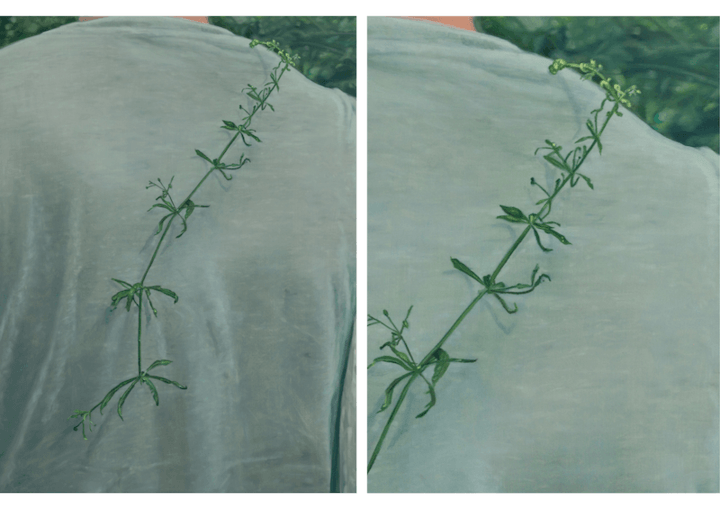
My birthday is in July, so I've always had a fondness for summer. At primary school we changed into gingham summer dresses, played in the park with friends after school, climbed trees, stuck goosegrass on each other's clothes and had water fights. It was a time before office jobs and sweaty commutes.
Your compositions often feel cinematic. Are there filmmakers or photographers who have shaped the way you frame everyday life?
I'm hugely inspired by John Wilson's documentaries, Martin Parr's intimate, satirical, anthropological photographs, and films by Sofia Coppola and Spike Lee. I often zoom in on a scene, which I suppose is a technique I've borrowed from film.
Public spaces play a central role in your paintings. What interests you about the quiet theatre of strangers sharing the same environment?
In everyday life, the most mundane moments often happen outside the home, on the journey to and from work or while running errands. Relatability is important to me, but people also do strange things. Even when no one is visible in a scene, there can still be traces of their presence left behind.
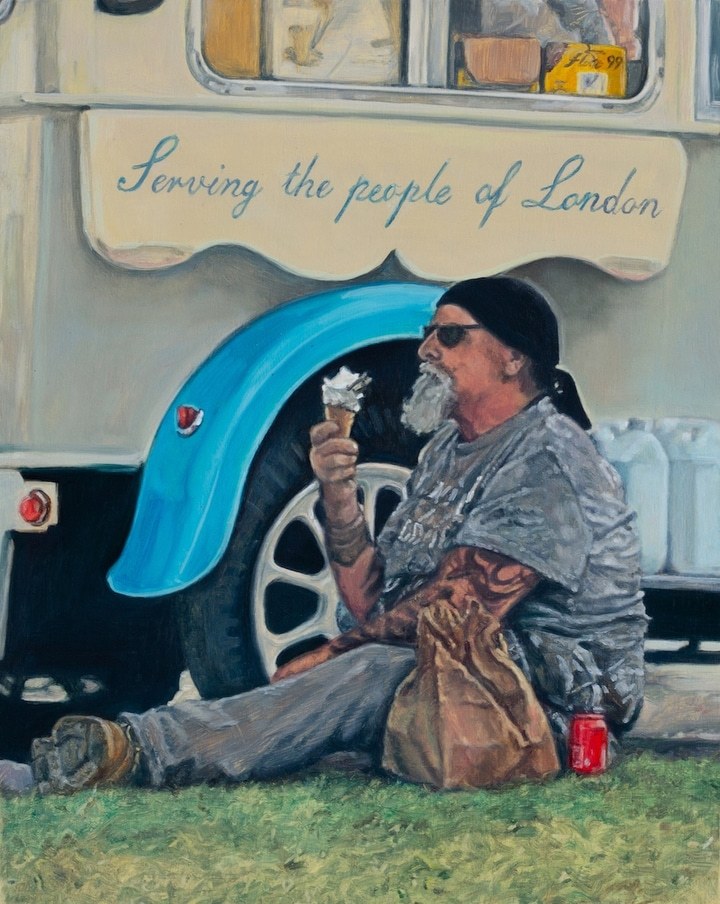
If someone from fifty years in the future looked at this series, what do you hope they would understand about Britain today?
I don't have much hope for fifty years from now. Maybe I'm documenting the beginning of the end. But if there's even a small chance that things can be turned around, I hope the work will still feel relatable. I hope we still have plants and animals that haven't been driven extinct by the climate crisis. As for summer in fifty years' time, who knows if it'll even be enjoyable? We could all be stuck indoors with the air conditioning on full blast.
What do these paintings reveal about British summertime that a photograph couldn't?
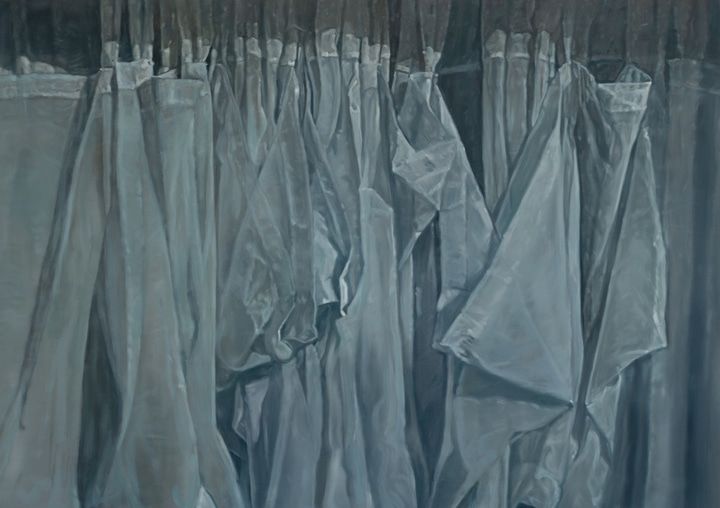
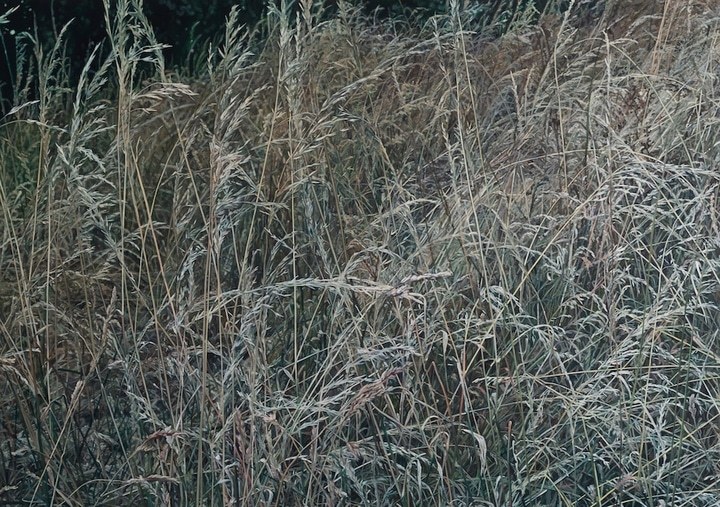
My paintings are different from the original photographs they're based on; I'm not aiming for photorealism. The paint and brushstrokes create layers and textures that a photograph can't. While It's Nice Out took months of layering to complete, with each day bringing a fresh insight. I think that invites people to spend longer looking, gradually discovering more details.
After spending so much time observing everyday life, has your definition of what makes a moment "special" changed?
I look at people more than I used to. I take photographs constantly and almost obsessively. Most of them never get used, but there are recurring themes: England flags, pets and the strange things people throw away. I think the best moments have a hint of the surreal or the misplaced. They're familiar, but just unsettling enough to make you look twice.
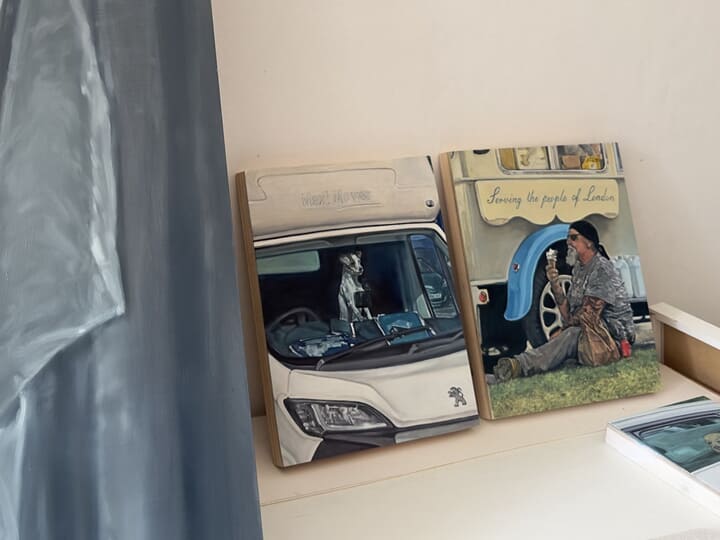
While It's Nice Out by Bianca MacCall
This series explores the English summer in urban spaces, sometimes incorporating small glimpses of the natural world within the city. Each painting centres on the idea of pausing, or finding a brief escape from work. Although the scenes are sunlit and appear cheerful on the surface, the cool colour palette lends them an underlying melancholy. They celebrate the quiet rituals and fleeting absurdities of everyday life while reflecting on how quickly the world around us is changing.