%20--%3e%3csvg%20version='1.1'%20id='Layer_1'%20xmlns='http://www.w3.org/2000/svg'%20xmlns:xlink='http://www.w3.org/1999/xlink'%20x='0px'%20y='0px'%20viewBox='0%200%201440%20384.8'%20style='enable-background:new%200%200%201440%20384.8;'%20xml:space='preserve'%3e%3cstyle%20type='text/css'%3e%20.st0{fill:%23010101;}%20%3c/style%3e%3cg%3e%3cpath%20class='st0'%20d='M156.5,162.6c0,32.3-14.1,52.7-42.3,61.1l51.3,71.2h-42.1L76.6,229H33.1v65.9H0v-196h72.9%20c29.9,0,51.3,5,64.2,15.1C150,124.2,156.5,140.3,156.5,162.6z%20M112.5,190.3c6.7-5.8,10.1-15.1,10.1-27.9c0-12.8-3.5-21.6-10.4-26.4%20c-6.9-4.8-19.3-7.2-37-7.2H33.1V199h41.2C93,199,105.7,196.1,112.5,190.3z'/%3e%3cpath%20class='st0'%20d='M407.1,124.7c-9.6,0-17.5,2-23.7,5.9c-6.2,3.9-9.3,9.9-9.3,17.8c0,7.9,3.1,14,9.3,18.2%20c6.2,4.2,19.3,8.7,39.4,13.6c20.1,4.9,35.2,11.7,45.4,20.5c10.2,8.8,15.3,21.7,15.3,38.8c0,17.1-6.5,31-19.3,41.6%20c-12.9,10.7-29.8,16-50.8,16c-30.7,0-57.9-10.6-81.6-31.7l20.8-25c19.8,17.2,40.4,25.8,61.7,25.8c10.7,0,19.1-2.3,25.4-6.9%20c6.3-4.6,9.4-10.7,9.4-18.2c0-7.6-2.9-13.5-8.8-17.7c-5.9-4.2-16-8-30.4-11.5c-14.4-3.5-25.3-6.6-32.8-9.5%20c-7.5-2.9-14.1-6.7-19.9-11.4c-11.6-8.8-17.4-22.2-17.4-40.4s6.6-32.1,19.8-41.9c13.2-9.8,29.5-14.7,48.9-14.7%20c12.5,0,25,2.1,37.3,6.2c12.3,4.1,23,9.9,32,17.4l-17.7,25c-5.8-5.2-13.7-9.5-23.6-12.9C426.5,126.4,416.7,124.7,407.1,124.7z'/%3e%3cpath%20class='st0'%20d='M690.2,98.9V130H585.6v51.9h93.9v29.4h-93.9v52.4h108v31.1H552.5v-196H690.2z'/%3e%3cg%3e%3cpath%20class='st0'%20d='M868.7,250.3l-19.6,44.6h-35.3l86.4-196h35.3l86.4,196h-35.3l-19.6-44.6H868.7z%20M953.4,219.8L917.8,139%20l-35.6,80.8H953.4z'/%3e%3cpath%20class='st0'%20d='M1233.6,162.6c0,32.3-14.1,52.7-42.3,61.1l51.3,71.2h-42.1l-46.8-65.9h-43.5v65.9h-33.1v-196h72.9%20c29.9,0,51.3,5,64.2,15.1C1227.1,124.2,1233.6,140.3,1233.6,162.6z%20M1189.6,190.3c6.7-5.8,10.1-15.1,10.1-27.9%20c0-12.8-3.5-21.6-10.4-26.4c-6.9-4.8-19.3-7.2-37-7.2h-42.1V199h41.2C1170.1,199,1182.8,196.1,1189.6,190.3z'/%3e%3cpath%20class='st0'%20d='M1380.5,129.2v165.7h-33.1V129.2H1288V98.9h152v30.3H1380.5z'/%3e%3c/g%3e%3cg%3e%3crect%20x='234.9'%20y='0'%20class='st0'%20width='29.1'%20height='384.8'/%3e%3c/g%3e%3c/g%3e%3c/svg%3e)

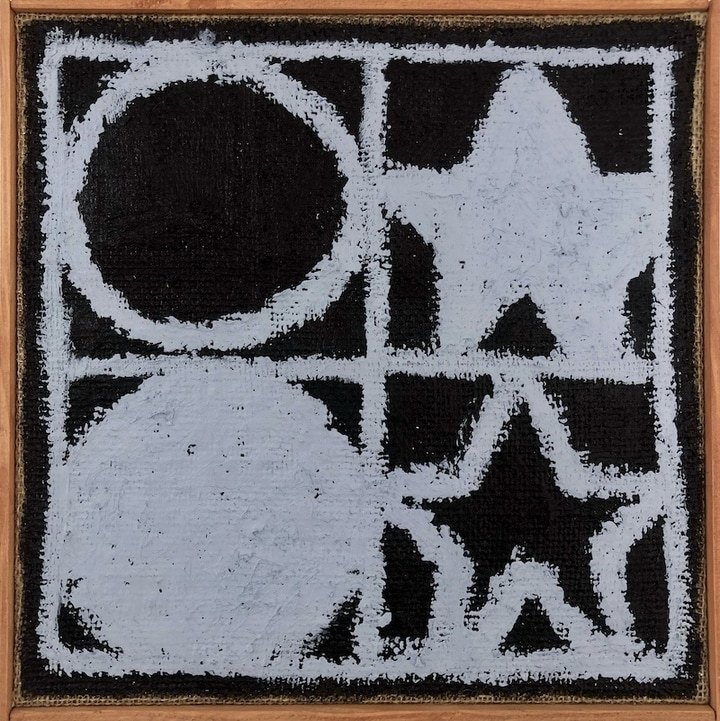
One of the first things to strike me in these works is their deliberately bright, almost childlike register. Attention to detail is secondary to form: thick cuts of jute and linen, bonded with glue, carry blocks of paint, oil pastel and oil bar wax. The surfaces are rough and purposeful, the materials loose but hard-wearing.
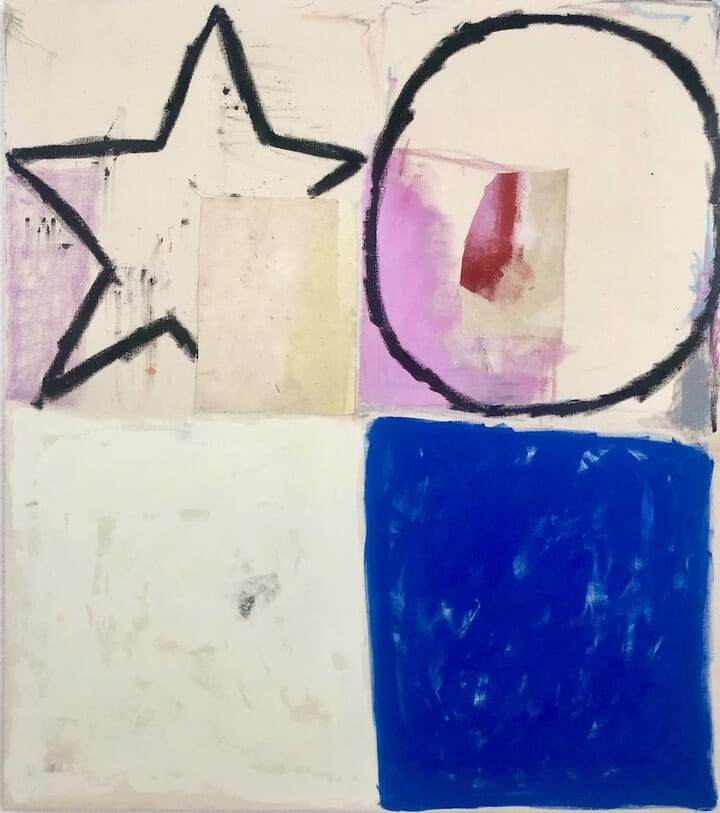
Each work is divided into four sections. Textured edges emphasise process over finish, suggesting a modular, almost provisional logic. Upon viewing, my experience is one of comfort. There is something resolutely calming about the stars and circles that sit contentedly in their respective boxes, and the earthy humanness that emanates from the fraying material, like loose threads from a beloved, well-worn jumper. “These are the paintings I’ve always wanted to make,” Peter Evans tells me. “I don’t like work that’s overly didactic. I don’t want to dictate your experience of my work. Art should remain open to interpretation.”
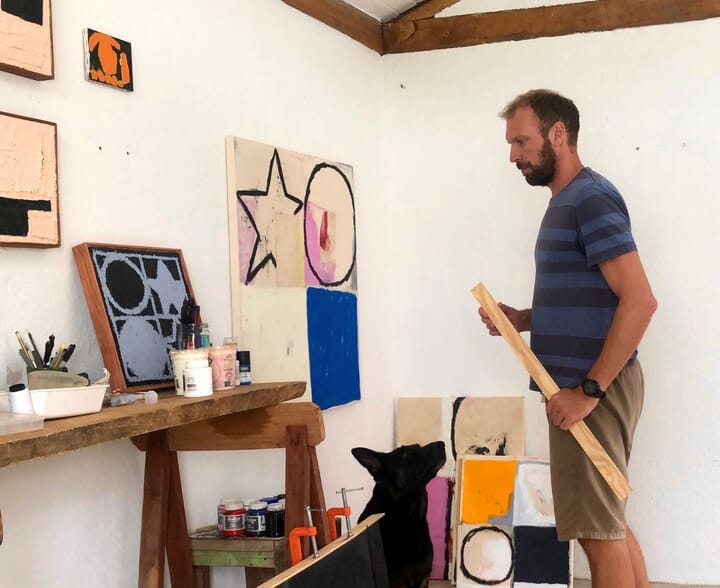
This resistance to fixed meaning is not a rejection of rigour but the result of it. Evans’ practice has been shaped by a prolonged negotiation with the demands of conceptual thinking, an educational ride that began during his time at Chelsea School of Art. While he speaks positively of the experience, he also remembers the pressure to justify every decision as stifling. “Everything felt like it had to have a deeper meaning,” he recalls. “But I wasn’t sure if I wanted my art to change the world; I just knew I wanted to make art.”
His current paintings extend what Evans refers to as his Freedom Abstracts: a sustained effort to disengage from programmatic intention, reasserting intuition and the act of making for his own satisfaction. His patchwork, cut-and-stick approach draws on the strategies of post-war décollage artists of the 1950s and 60s, including Raymond Hains and Mimmo Rotella, as well as the disruptive logic of photomontage originator Hannah Höch. Rather than quoting these figures directly, Evans uses them as a catalyst for loosening authorship in his own practice, dismantling the rules and intellectual frameworks that govern artistic expression.
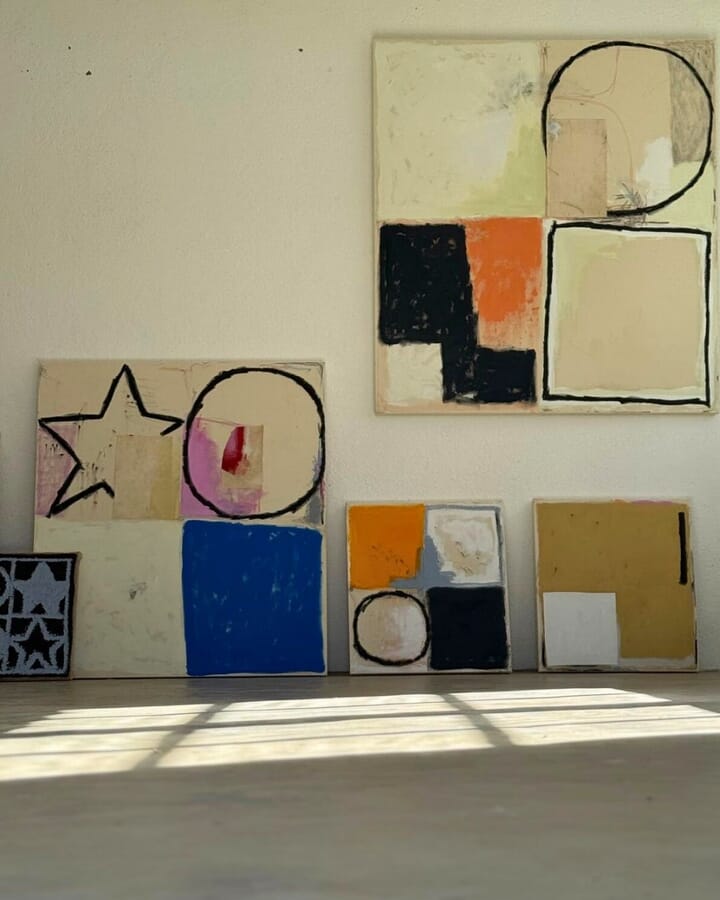
With this in mind, Evans allows ambiguity to function as a working principle rather than a required outcome. Meaning is neither foreclosed nor actively proposed; instead, it remains contingent, emerging through material encounter. In this sense, his work resists the rhetorical closure of overtly political or didactic art, favouring a conceptual laxity that places responsibility and possibility back onto the viewer.
Medium is central to this position. While the post-war photomontagists tore down old posters and billboards for their work, Evans’ material collection is a little different. He lives on a remote working cattle farm in Brazil with his wife and daughter, several kilometres from the nearest village. His immediate environment feeds directly into the work. Unlike the urban scavenging of earlier collage practices, his materials are harvested from agricultural life: old coffee sacks and fabric marked by use. These elements introduce a physical and cultural specificity without tipping into illustration, allowing Evans to ground the paintings in place while refusing narrative.
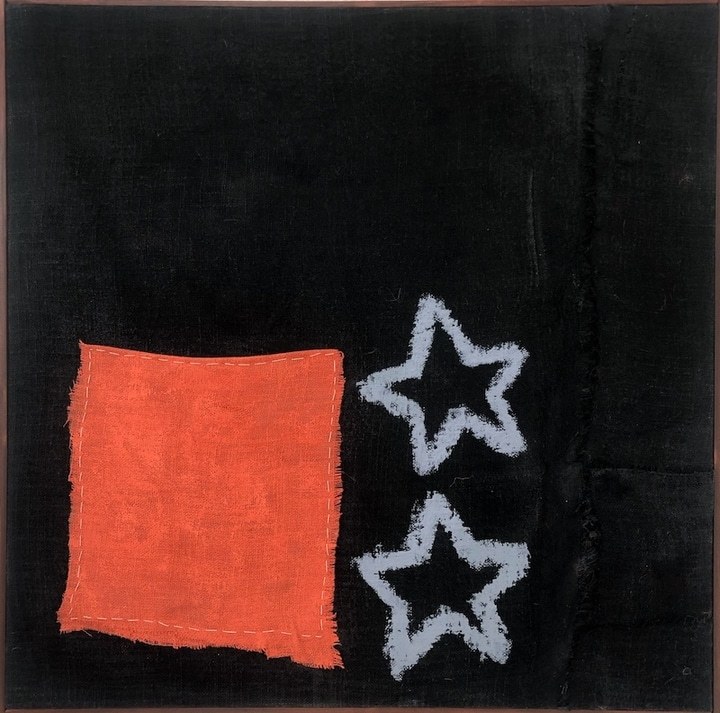
Surrounded by farm animals and the expansive landscapes that once fuelled his childhood fantasies of cowboys and pilgrimage, Evans saves and recycles materials from the farm and of the land to produce visibly and sensorially tactile works. Glue, fabric and pigment accumulate through repeated handling, reinforcing a process that is bodily and immediate. While he describes the act of making and recycling as cathartic, the work itself remains disciplined, holding a productive tension between construction and play.
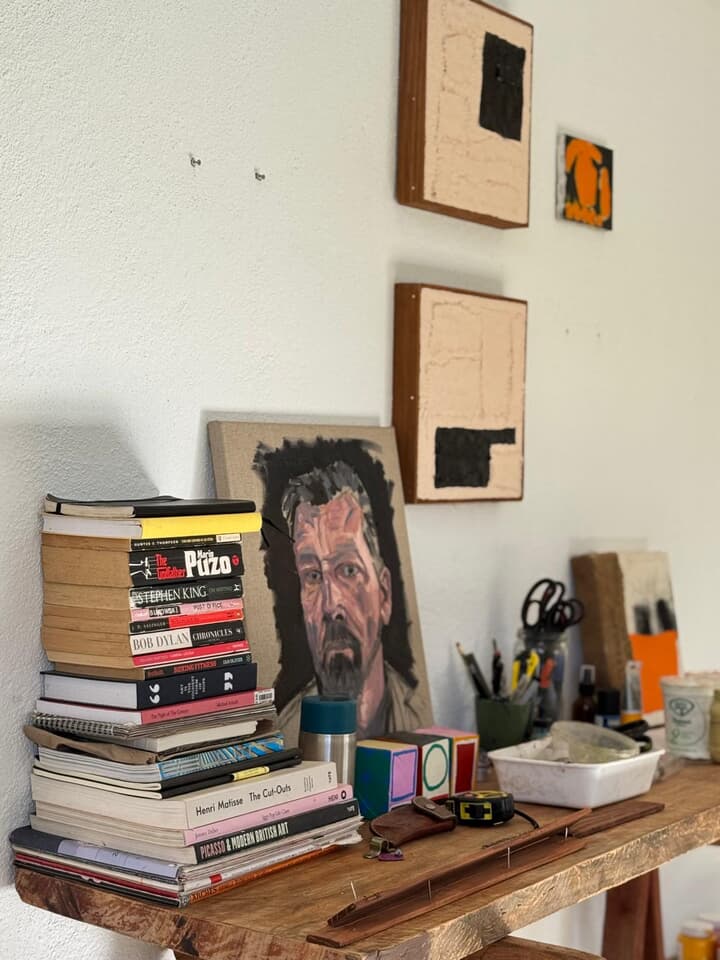
Without falling into the trap of conclusion that Evans quietly eschews, what distinguishes this series is not its embrace of freedom as an aesthetic position, but its refusal to instrumentalise it. These paintings do not argue for openness; they simply are open. Evans withholds any instructions from the viewer, allowing the works to operate on their own terms.