%20--%3e%3csvg%20version='1.1'%20id='Layer_1'%20xmlns='http://www.w3.org/2000/svg'%20xmlns:xlink='http://www.w3.org/1999/xlink'%20x='0px'%20y='0px'%20viewBox='0%200%201440%20384.8'%20style='enable-background:new%200%200%201440%20384.8;'%20xml:space='preserve'%3e%3cstyle%20type='text/css'%3e%20.st0{fill:%23010101;}%20%3c/style%3e%3cg%3e%3cpath%20class='st0'%20d='M156.5,162.6c0,32.3-14.1,52.7-42.3,61.1l51.3,71.2h-42.1L76.6,229H33.1v65.9H0v-196h72.9%20c29.9,0,51.3,5,64.2,15.1C150,124.2,156.5,140.3,156.5,162.6z%20M112.5,190.3c6.7-5.8,10.1-15.1,10.1-27.9c0-12.8-3.5-21.6-10.4-26.4%20c-6.9-4.8-19.3-7.2-37-7.2H33.1V199h41.2C93,199,105.7,196.1,112.5,190.3z'/%3e%3cpath%20class='st0'%20d='M407.1,124.7c-9.6,0-17.5,2-23.7,5.9c-6.2,3.9-9.3,9.9-9.3,17.8c0,7.9,3.1,14,9.3,18.2%20c6.2,4.2,19.3,8.7,39.4,13.6c20.1,4.9,35.2,11.7,45.4,20.5c10.2,8.8,15.3,21.7,15.3,38.8c0,17.1-6.5,31-19.3,41.6%20c-12.9,10.7-29.8,16-50.8,16c-30.7,0-57.9-10.6-81.6-31.7l20.8-25c19.8,17.2,40.4,25.8,61.7,25.8c10.7,0,19.1-2.3,25.4-6.9%20c6.3-4.6,9.4-10.7,9.4-18.2c0-7.6-2.9-13.5-8.8-17.7c-5.9-4.2-16-8-30.4-11.5c-14.4-3.5-25.3-6.6-32.8-9.5%20c-7.5-2.9-14.1-6.7-19.9-11.4c-11.6-8.8-17.4-22.2-17.4-40.4s6.6-32.1,19.8-41.9c13.2-9.8,29.5-14.7,48.9-14.7%20c12.5,0,25,2.1,37.3,6.2c12.3,4.1,23,9.9,32,17.4l-17.7,25c-5.8-5.2-13.7-9.5-23.6-12.9C426.5,126.4,416.7,124.7,407.1,124.7z'/%3e%3cpath%20class='st0'%20d='M690.2,98.9V130H585.6v51.9h93.9v29.4h-93.9v52.4h108v31.1H552.5v-196H690.2z'/%3e%3cg%3e%3cpath%20class='st0'%20d='M868.7,250.3l-19.6,44.6h-35.3l86.4-196h35.3l86.4,196h-35.3l-19.6-44.6H868.7z%20M953.4,219.8L917.8,139%20l-35.6,80.8H953.4z'/%3e%3cpath%20class='st0'%20d='M1233.6,162.6c0,32.3-14.1,52.7-42.3,61.1l51.3,71.2h-42.1l-46.8-65.9h-43.5v65.9h-33.1v-196h72.9%20c29.9,0,51.3,5,64.2,15.1C1227.1,124.2,1233.6,140.3,1233.6,162.6z%20M1189.6,190.3c6.7-5.8,10.1-15.1,10.1-27.9%20c0-12.8-3.5-21.6-10.4-26.4c-6.9-4.8-19.3-7.2-37-7.2h-42.1V199h41.2C1170.1,199,1182.8,196.1,1189.6,190.3z'/%3e%3cpath%20class='st0'%20d='M1380.5,129.2v165.7h-33.1V129.2H1288V98.9h152v30.3H1380.5z'/%3e%3c/g%3e%3cg%3e%3crect%20x='234.9'%20y='0'%20class='st0'%20width='29.1'%20height='384.8'/%3e%3c/g%3e%3c/g%3e%3c/svg%3e)
Artist in Residence: Fa Razavi | Rise Art
Fa Razavi: The Rise Art Residency at House of Hulda, Norway

Artist in Residence
Fa Razavi
For the second iteration of their residency partnership, Rise Art and House of Hulda invited Fa Razavi, whose multidisciplinary practice explores the unstable terrain of memory and displacement.
Razavi approaches image-making as a site of reconstruction, where personal and cultural histories are continually reassembled rather than resolved. During her residency, this inquiry encountered a markedly different set of conditions. Rather than prompting a visible rupture, House of Hulda introduced a kind of spatial and temporal dislocation that subtly reoriented her process.
Removed from the density of the urban and the immediacy of lived reference, Razavi’s attention shifted towards intervals: pauses, silences, and the thresholds between presence and absence. The landscape that is at once austere and atmospheric did not assert itself as subject, but operated more obliquely, as a field against which perception could loosen and drift.
Rise Art shines a light on today's most dynamic and culturally significant artists, collaborating directly with a curated roster of emerging, mid-career, and established creatives worldwide.
House of Hulda is a registered non-profit organisation aiming to provide artists with much needed space and time to develop their practice and find inspiration. All proceeds go towards upkeep, development and growth of the home-and-studio space they occupy in the small village of Stave, Andøya.
Photography courtesy of Mariell Lind Hansen, co-founder of House of Hulda.
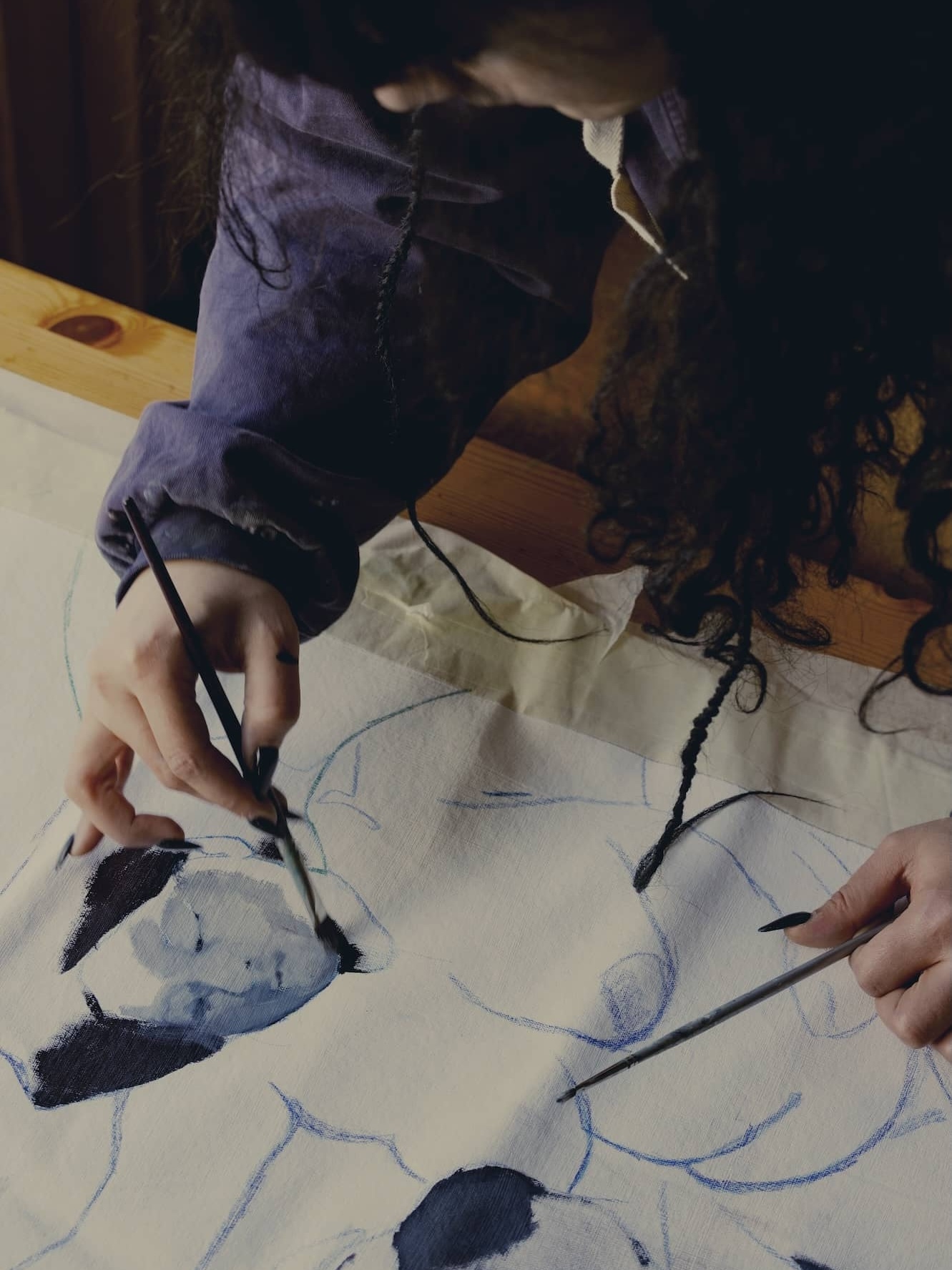
“At House of Hulda, I didn’t change direction so much as deepen my existing concerns. The work I made moved away from direct expression towards suggestion, holding meaning in suspension and resisting closure.”
– Fa Razavi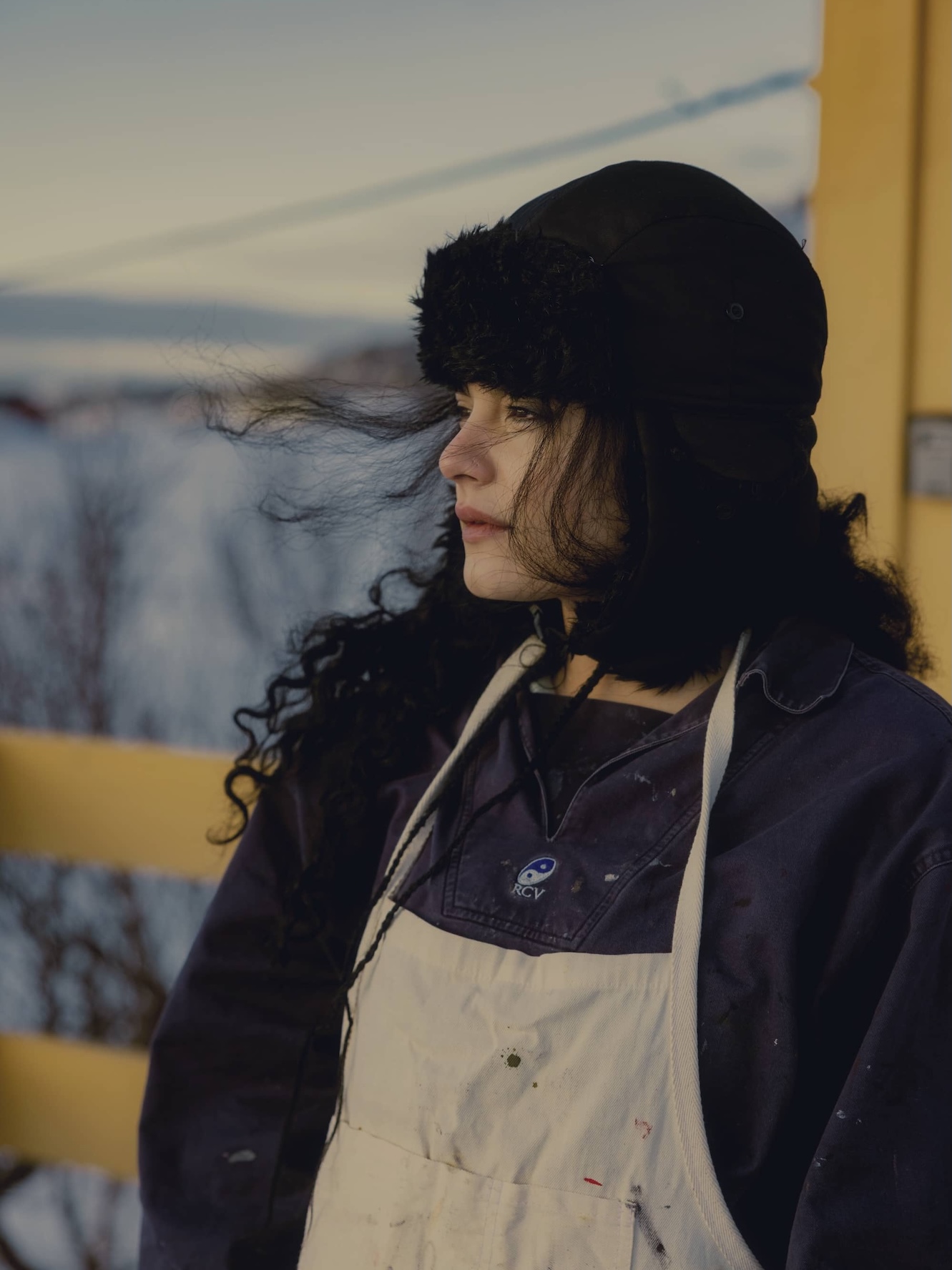
About Fa Razavi
Born in 1996 in Bushehr, Iran, Fa Razavi is a multidisciplinary artist who works across film, performance, object-making, and painting. Her work, which explores ideas and experiences of displacement and memory, was recently shortlisted for the Freelands Painting Prize. She graduated from Middlesex University with a BA (Hons) in Fine Art. Razavi also previously studied Iranian Fashion and Clothing and was a sculpture associate at the Art University of Tehran. The artist now lives and works in London.
view artist profileIn Conversation: Fa Razavi
Your work often navigates displacement and the politics of belonging. How did being in rural Norway complicate or shift that narrative?
In Norway, belonging or displacement didn’t really apply. I was somewhere in between. I wasn’t part of the place, but I wasn’t fully outside of it either. I was there to observe. I became aware of myself as the one who looks, engaging with the place through seeing rather than belonging.
Your palette often carries symbolic weight. Did the light, climate, or mood of Norway shift your use of colour?
The colours overwhelmed me; they were intense and constantly changing. I couldn’t fix them. I wanted to hold onto all of them at once, but I couldn’t. So I let them go and turned to the space between them. What remained was the silence of the snow – a quiet space that seemed to hold things apart, and at the same time, hold them together.
How did the solitude of House of Hulda affect the emotional intensity often present in your work?
The solitude slowed everything down. My figures became still, almost asleep. The emotion remains, but it turned inward – held rather than expressed.