%20--%3e%3csvg%20version='1.1'%20id='Layer_1'%20xmlns='http://www.w3.org/2000/svg'%20xmlns:xlink='http://www.w3.org/1999/xlink'%20x='0px'%20y='0px'%20viewBox='0%200%201440%20384.8'%20style='enable-background:new%200%200%201440%20384.8;'%20xml:space='preserve'%3e%3cstyle%20type='text/css'%3e%20.st0{fill:%23010101;}%20%3c/style%3e%3cg%3e%3cpath%20class='st0'%20d='M156.5,162.6c0,32.3-14.1,52.7-42.3,61.1l51.3,71.2h-42.1L76.6,229H33.1v65.9H0v-196h72.9%20c29.9,0,51.3,5,64.2,15.1C150,124.2,156.5,140.3,156.5,162.6z%20M112.5,190.3c6.7-5.8,10.1-15.1,10.1-27.9c0-12.8-3.5-21.6-10.4-26.4%20c-6.9-4.8-19.3-7.2-37-7.2H33.1V199h41.2C93,199,105.7,196.1,112.5,190.3z'/%3e%3cpath%20class='st0'%20d='M407.1,124.7c-9.6,0-17.5,2-23.7,5.9c-6.2,3.9-9.3,9.9-9.3,17.8c0,7.9,3.1,14,9.3,18.2%20c6.2,4.2,19.3,8.7,39.4,13.6c20.1,4.9,35.2,11.7,45.4,20.5c10.2,8.8,15.3,21.7,15.3,38.8c0,17.1-6.5,31-19.3,41.6%20c-12.9,10.7-29.8,16-50.8,16c-30.7,0-57.9-10.6-81.6-31.7l20.8-25c19.8,17.2,40.4,25.8,61.7,25.8c10.7,0,19.1-2.3,25.4-6.9%20c6.3-4.6,9.4-10.7,9.4-18.2c0-7.6-2.9-13.5-8.8-17.7c-5.9-4.2-16-8-30.4-11.5c-14.4-3.5-25.3-6.6-32.8-9.5%20c-7.5-2.9-14.1-6.7-19.9-11.4c-11.6-8.8-17.4-22.2-17.4-40.4s6.6-32.1,19.8-41.9c13.2-9.8,29.5-14.7,48.9-14.7%20c12.5,0,25,2.1,37.3,6.2c12.3,4.1,23,9.9,32,17.4l-17.7,25c-5.8-5.2-13.7-9.5-23.6-12.9C426.5,126.4,416.7,124.7,407.1,124.7z'/%3e%3cpath%20class='st0'%20d='M690.2,98.9V130H585.6v51.9h93.9v29.4h-93.9v52.4h108v31.1H552.5v-196H690.2z'/%3e%3cg%3e%3cpath%20class='st0'%20d='M868.7,250.3l-19.6,44.6h-35.3l86.4-196h35.3l86.4,196h-35.3l-19.6-44.6H868.7z%20M953.4,219.8L917.8,139%20l-35.6,80.8H953.4z'/%3e%3cpath%20class='st0'%20d='M1233.6,162.6c0,32.3-14.1,52.7-42.3,61.1l51.3,71.2h-42.1l-46.8-65.9h-43.5v65.9h-33.1v-196h72.9%20c29.9,0,51.3,5,64.2,15.1C1227.1,124.2,1233.6,140.3,1233.6,162.6z%20M1189.6,190.3c6.7-5.8,10.1-15.1,10.1-27.9%20c0-12.8-3.5-21.6-10.4-26.4c-6.9-4.8-19.3-7.2-37-7.2h-42.1V199h41.2C1170.1,199,1182.8,196.1,1189.6,190.3z'/%3e%3cpath%20class='st0'%20d='M1380.5,129.2v165.7h-33.1V129.2H1288V98.9h152v30.3H1380.5z'/%3e%3c/g%3e%3cg%3e%3crect%20x='234.9'%20y='0'%20class='st0'%20width='29.1'%20height='384.8'/%3e%3c/g%3e%3c/g%3e%3c/svg%3e)

In this interview, led by our Head of Artists, Laurel Bouye, Steph Goodger reflects on the formative stories that shaped her early interest in war and social history, the techniques and texts guiding her new paintings, and the urgent global contexts that continue to sharpen her sense of artistic responsibility.
Growing up, were there any particular experiences or environments that you feel shaped your interest in themes like social history, conflict, or trauma?
My parents’ house was, and still is, full of books. Many obscure volumes lived in my father’s study, and many classics of literature came from my mother’s student days. She studied Literature, and my father is a Dr of Sociology and was a lecturer.
My paternal grandfather spoke to me a lot about his life. He rose from a very poor background to become a cabinet maker and teacher. He became the first post-war (WWII) Principal of Rycotewood College in Thame, Oxfordshire. It specialised in giving young men from deprived backgrounds a trade in cabinet-making, carpentry, or agricultural engineering. The Rycotewood Furniture Centre still exists!
I was also allowed to play with my maternal grandfather’s old WWI field binoculars as a child. The thick leather case had a bullet hole going clean through the middle. Stephen died the year I was born. I was often told what sounded like mythical stories about a great battle he had been involved in when he was young.
Visiting the Bayeux Tapestry on a holiday to Normandy when I was five, I was fascinated by the way the Battle of Hastings was depicted, and by Harold with the arrow in his eye. It was another fantastical battle from the distant past.
Can you discuss the inspiration and process behind your Valley Series and Crossing Series?
‘‘.. the most convincing character of reality is the unreal quality of the scene … It is like a battle in a dream, fought out amongst green hills and flowering hedges..."
Paul Nash (British War Artist), 1917
I thought for ages that Nash was describing the dream-like quality of the WWI battlefield, but he was actually talking about Uccello’s The Battle of San Romano. The series of three paintings by Uccello reminds me a lot of the Bayeux Tapestry and, as with Nash’s paintings, gives a sense of the immersive, unreal feeling of the war zone – this quality of battle that has followed me since childhood.
Nash’s paintings of the trenches inspired the way I dealt with the landscape of conflict in both The Valley and The Crossing. The idea of the earth as an analogous ‘body’ taking on and expressing trauma, reflecting the extreme mental and physical trauma of war.
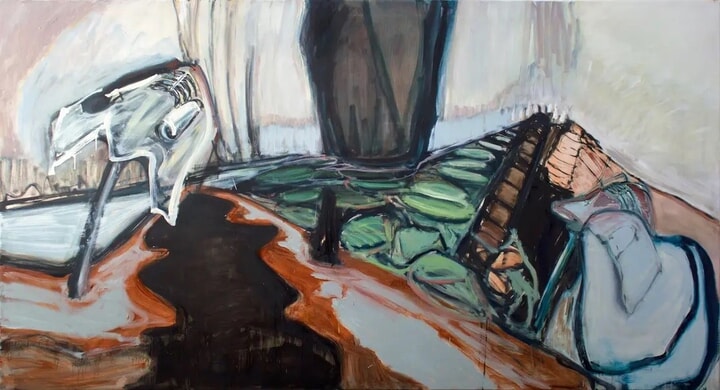
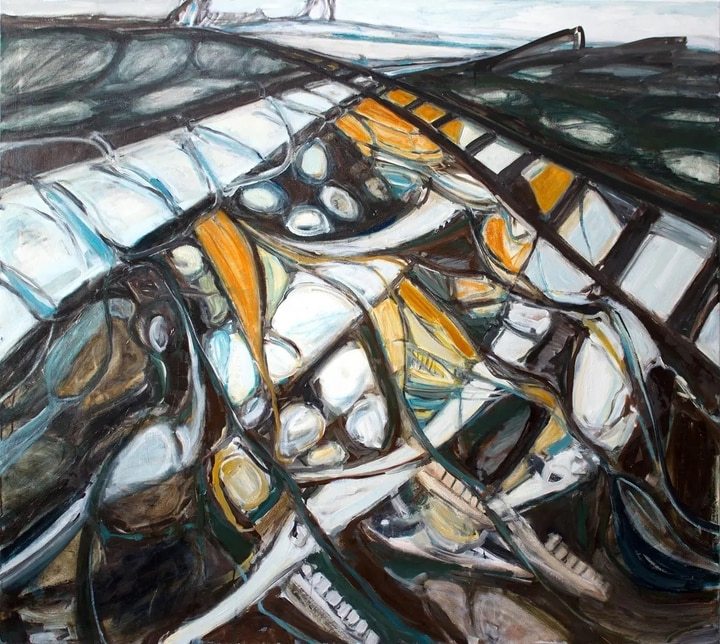
In The Valley, the earth absorbs the energy of the explosion into itself, then expresses it by breaking up, splitting into angular shards, and forming opaque streams or pools.
The Crossing series focuses on a meeting place. It developed from elements of The Valley series, where a railway track and a river intersect and the railway track crosses over.
The image of a meeting place also originated from T. S. Eliot’s The Hollow Men (1925): (IV). “ ..In this last of meeting places.. Gathered on this beach of the tumid river.”
Did you employ any new techniques or materials in these series compared to earlier works, and if so, what led to those shifts?
Not new exactly, as I have used collage, photomontage and drawing before in other series. But perhaps its use here is more integrated with the painting process than before.
From an extensive archive of photographs of WWI trench warfare, I started to create collages by cutting up photocopies. Then I drew on top of them. These were works in their own right and also served as models for paintings. Firstly, a series of small, oval oil paintings called Pearls. Then I fused some of these collages together digitally to create a panorama, which developed into The Valley series of large panoramic oil paintings.
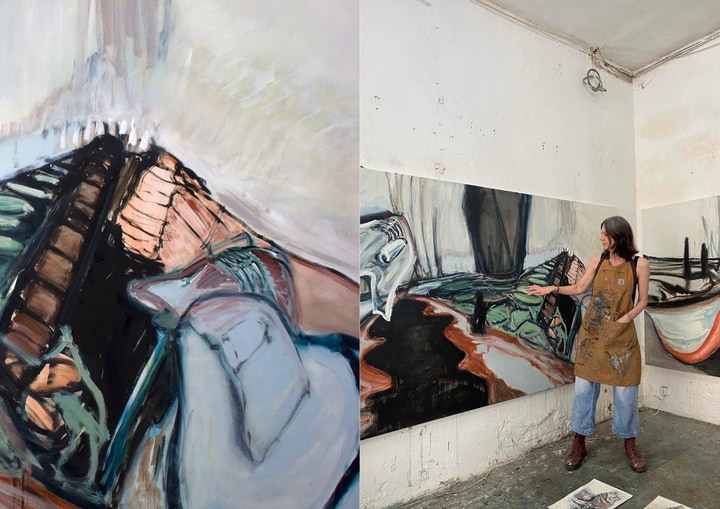
Working in this way helped me to stay close to the subject, but also to distil the imagery into some key elements: the explosion, the stream, and the railway track, which some interpret as a trench ladder. Chopping up and reconfiguring the photographs, and then the collages themselves, felt analogous to the very notion of the landscape as an ever-mutating, shifting body, breaking apart and coming back together again in new configurations.
The repeated cross shape in The Crossing series developed by playing with the paintings digitally, turning them around and repeating parts until an image appeared like a kind of stitching, holding the surface together.
Were there any particular literary or philosophical texts that were central to the conceptual development of either The Valley or The Crossing?
I called the first collages and the oval paintings Pearls after this quote from Shakespeare's The Tempest, Ariel’s song:
Full fathom five thy father lies;
Of his bones are coral made;
Those are pearls that were his eyes;
Nothing of him that doth fade,
But doth suffer a sea change
Into something rich and strange.
It’s a poignant image of transformation after death, of the drowned father. The theme of transformation runs right through, from the first collages to The Crossing series. In one collage, for example, I stuck rose petals onto a soldier’s head, where it had been blown apart. In another, I turned a colonial, Highland Regiment cap badge into the sun.
The image of a meeting place, as I mentioned before, originated from T. S. Eliot’s The Hollow Men, 1925. The place is the ‘twilight kingdom’. There are recurring references to eyes, and also to roses and broken jaws, which appear in some form in my later Crossing series. The poem begins:
Mistah Kurtz—he dead..
This is a reference to Joseph Conrad’s elusive and illusive central character Kurtz in Heart of Darkness. Conrad explores the notion of the hollow or empty men of empire. He compares the colonial staff of the Belgian Congo trading post to such things as shop-store dummies or tailors’ mannequins, invoking their moral and emotional bankruptcy. I also drew heavily on the atmosphere created in both Conrad’s Heart of Darkness and Eliot’s The Hollow Men for my series on WWI landscapes.
Your process involves extensive research, reading, and archive searching before touching a brush. Can you describe a time when a particular piece of historical information or a photograph deeply resonated with you and directly led to a breakthrough in an artwork's concept or execution?
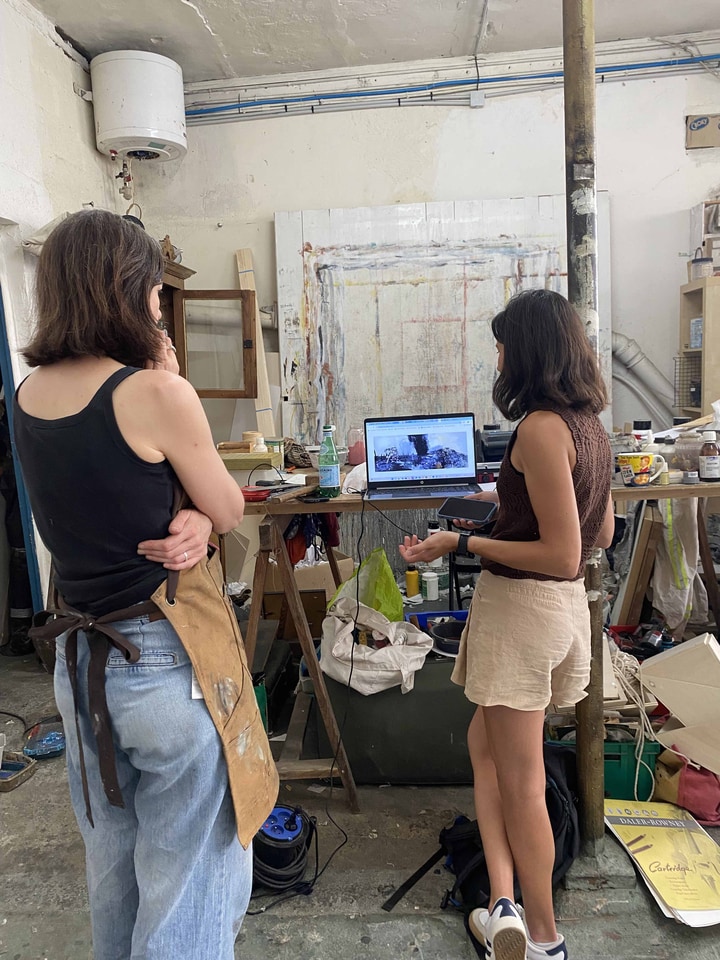
That is how I mostly work, so lots of examples! Reading the War Diary of the 12th (Heavy) Battery, Royal Garrison Artillery (May 1915–October 1916), the entry recorded on 2 August 1916 at the Battle of the Somme describes my grandfather Stephen as one of two men wounded in an explosion between 8.30 and 9 am, and sent to an ambulance with shell-shock. I experienced a kind of fold in time, where the more than 100 years’ distance disappeared. My mission then became to find photographs of him in the historical record. I never found him, or maybe I passed over him, but I accumulated a vast archive of photographs, which then became the collages.
What is your process for filtering or translating these vast subjects into the more intimate and imaginative realm of your paintings?
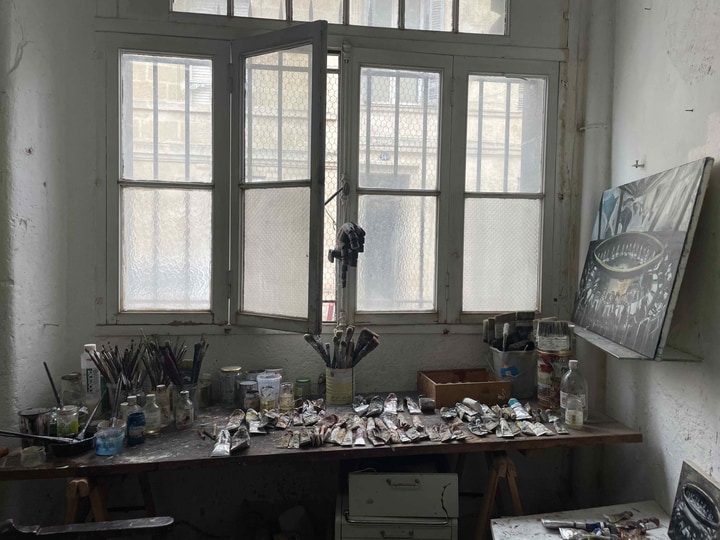
Filtering, translating, and processing take time. Each series has different requirements. I’ve employed tools such as drawing, collage, photomontage, and model-making to initially deal with source material such as photographs, bits of architecture, spaces, or objects, in order to reconstruct or transform them.
I do a lot of playing around with drawing and collage, both physical and digital, until things start to happen and a route opens up. It can also be a line from a poem that offers clarity, coherence, and direction to disparate elements which refuse to gel together otherwise.
Your work frequently addresses themes of conflict, trauma, and human vulnerability. To what extent do current global events inform or shape your artistic perspective on these subjects?
Increasingly! Focusing on historical themes, it’s important also to acknowledge that one is part of that history. Not simply living through it as an observer, but with an active role to play. After having tackled so many subjects relating to imperialism and colonialism, conflict and social injustice, I felt a call to action as I witnessed, through raw source footage taken by Gazan journalists, the genocide of the Gazan people.
Before this, I think I had missed something tying all my other themes together. Namely, that the post-WWII rules-based order is merely a façade, and the world is still fundamentally run with the same old brutality, very much along colonial lines by imperial monopolies who require endless war, division, and chaos to survive. Still run by the hollow men: Amnesty Int UK PR 15 July, 2025: EU foreign ministers reject opportunity to introduce arms embargoes or sanctions against Israeli ministers.
‘This will be remembered as one of the most disgraceful moments in the EU’s history’ — Agnès Callamard, Amnesty International’s Secretary General.
Le Monde, 11 September 2024. In May (2024), an overwhelming majority of the (UN) General Assembly asserted that Palestinians deserved full membership, a move blocked by the United States.
On 5 June 2025, the US vetoed for the fifth time a UN Security Council resolution calling for an “immediate, unconditional and permanent ceasefire” in Gaza, while the 14 remaining countries on the council voted in favour.
Have you recently explored other art forms or media beyond painting, and if so, what draws you to them?
In January 2024, I came across a photograph on Instagram of a baby girl killed in an Israel Defence Force bombardment on Gaza, still holding the piece of bread that had been her breakfast. More and more pictures came flooding onto my Instagram feed, of children killed, wounded, limbs blown off, horribly burnt and hideously disfigured in bombing raids and tank shelling. Then there were the sniper victims, shot in the head. These were soon followed by images of starving babies and children, and terrible skin infections.
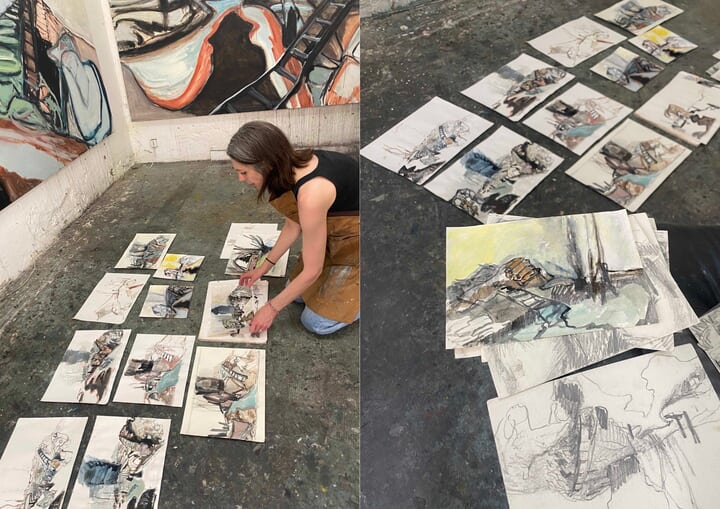
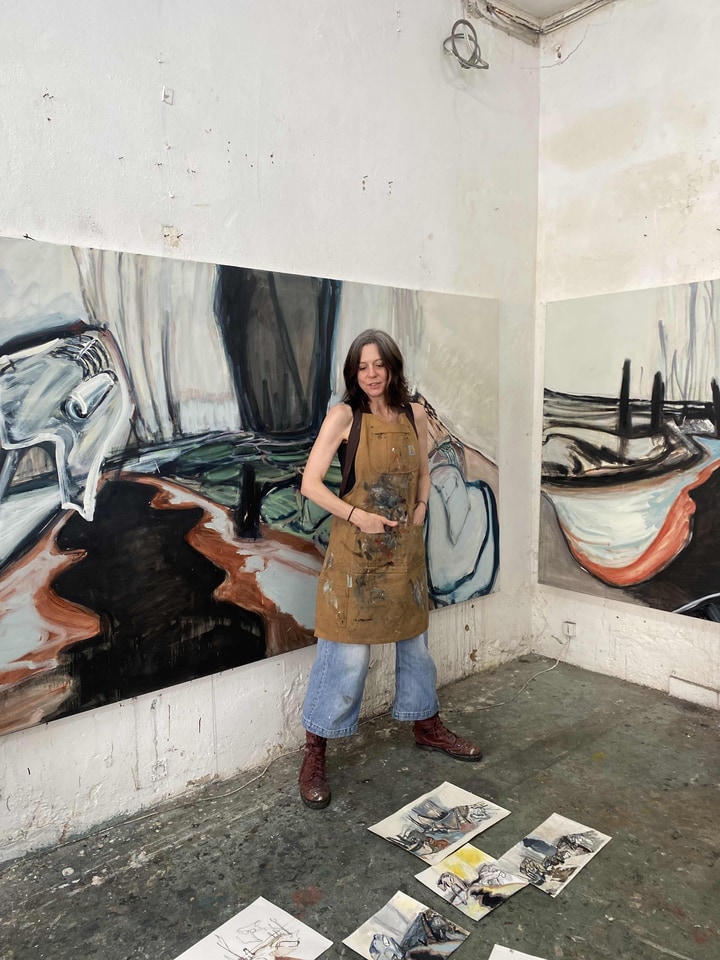
I felt it increasingly necessary to bear witness, as far as I could, to each child I came across. Drawing them directly from source footage by Gazan journalists, onto A5 paper with pencil and colour crayons, I also recorded all known facts about each child.
Are there any specific projects where these new media have become the primary output, rather than just a preliminary step?
(Reuters, 10 November 2023) “A child is killed on average every ten minutes in the Gaza Strip.” WHO Director-General Tedros Adhanom Ghebreyesus told the UN Security Council.
The film Every Ten Minutes was initially conceived as a means of bringing together all the drawings I had made and circulating them to the widest possible audience. The final edit of the long version presents 70 drawings and is 17 minutes long.
When the idea of a film arose, I consulted Maysaa, a friend in Gaza with whom I have corresponded for over a year. She asked her friend Suzan, herself a Gazan mother, if for the soundtrack she would sing the well-known Palestinian lullaby Yalla Tnam.
Suzan’s voice transformed and elevated the film into something much richer and more profoundly poignant. Her voice runs along every line, caressing and soothing, where the only peace to be found is in a world of dreams. Recalling the words of a poem by Mahmoud Darwish: ‘…They sleep beyond the limits of space, on a slop where words turn to stone..’ (On the slope, Higher than the Sea, They Slept.)